


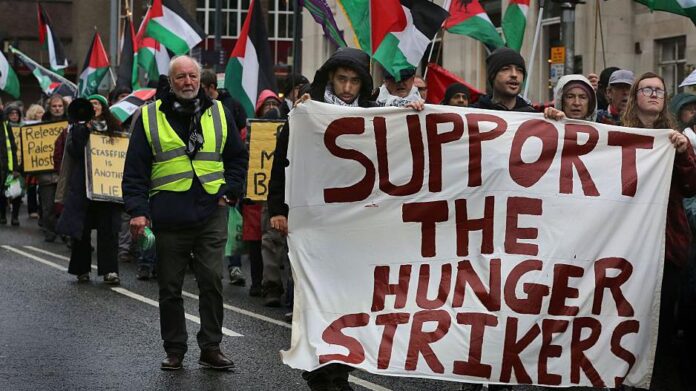
As the hunger strike of five prisoners in Britain enters its 50th day (since November 2nd) there is grave concern as to their health.
Bobby Sands, died on a hunger strike for “political status” -recognition as a political prisoner-after 66 days on May 5th 1981. Nine other Irish Republican Army (IRA) and Irish National Liberation Army (INLA) hunger strikers also died, one (Martin Hurson) after only 46 days. It is easy to calculate that the current hunger strikers are heading towards similarly tragic deaths, if their demands are not met.
***
The current strikers are, amongst other demands, seeking to end the politically motivated “terrorism” classification of their actions. Some of the wider group, known as the Filton 24, have been held on remand, without being charged with terrorism offence for over a year.
The UK’s new anti-terrorism laws, brought in by Keir Starmer’s Labour government are a license to circumvent due process and allow harsher punishments against peaceful protestors, who could only be accused of criminal damage at worst. The Ministry of Justice (MOJ) has washed its hands of direct responsibility for the potentially lethal consequences to the hunger strikers by saying,
“the prisons in question are independently run … the Deputy Prime Minister was being kept informed of the situation and that prisoners’ wellbeing is continually assessed, including hospitalisation, where deemed necessary by medical professionals.”
In other words, private sector companies such as Sodexo have the welfare of these strikers under their direct control and the Deputy Prime Minister and Justice Secretary, David Lammy, takes only a cursory interest. Lammy and Keir Starmer have repeatedly failed to respond to requests for a statement on this issue and the BBC – now the propaganda arm of the British state – didn’t report on this item of serious public concern for over a week between the 10th and 18th of December, until two of the, previously seven strikers came off hunger strike.
Lammy has also repeatedly failed to meet with prisoners or their representatives, with the excuse voiced by prison minister, Lord Timpson, that,
“I don’t treat any prisoners differently to others. That is why we will not meet any prisoners or their representatives.”
It is clear however, that these prisoners are being treated differently. The refusal to grant bail and have prisoners on remand for such a long-periods of time for non-violent offences where they will not be a danger to the general public, is highly irregular.
***
The hunger strikers have not been convicted of any offences and Amu Gibb, arrested in July 2025, is not expected to stand trial until January 2027, eighteen months after the arrest.
The hunger striker’s demands are simple and focus of five basic points:
- end prison censorship and the withholding of letters and calls
- immediate bail for Palestine Action prisoners
- fair trials for all those accused
- scrap the terror classification of Palestine Action
- shut down Elbit Systems sites in the UK.
Elbit systems is the Israeli government’s largest arms manufacturer and is active in arms production in the UK.
***
So far 62 MPs have signed an Early Day Motion calling on Lammy to intervene in order to find a solution to this situation, but he has not responded. This includes only a small minority of Labour MPs. The majority of Labour MPs, continue to sanction the genocidal actions of the Israeli state and the UK government’s complicity, through their silence.
Protests in support of the hunger striker’s rights cause continue, some large, others small. National protests and local protests still take place as regularly as ever. It is striking, however that the most back-ward far-right elements are emboldened by the authoritarian laws being promoted by the Starmer government as well as its racist immigration policies. Standing alongside people who have been protesting in support of the Palestinians for over two years it is clear that, mostly older male voices, heckle the events in increasing numbers, gaining confidence from the state’s tacit support of their hatred and vitriol. There is also a fear that violent attacks on these peaceful protests could become the order of the day. It is therefore vital that the, mostly older protestors on the local events, are supported by as many as possible and from a wide demographic.
As the days pass it is a daily worry that the health of the strikers collapses suddenly and they die. Reassurances by the state that they are working with the NHS and monitoring the situation will not prevent the inevitable consequence of prolonged starvation. The labour movement must bring all its power to bear in order for the state to at least negotiate a solution, otherwise the callous escalation of the situation will be the result of the state’s indifference to humanity and its authoritarian drive for more and more control, whatever the dreadful consequences may be for the welfare of its people.