

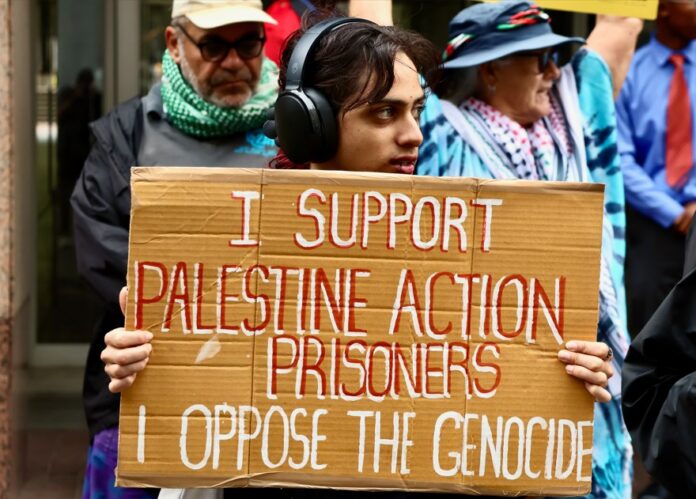
As the Palestine Action hunger strikes enter their 66th day, the UK government seems prepared to see the strikers die one by one, rather than begin meeting their demands or even agree to meet with the striker’s representatives.
Three of the eight people who began striking last year remain on strike with Tueta Hoxha being reported as suspending her hunger strike because some of her specific demands had been met. These include: the release of delayed mail accompanied by an apology and a confirmed visit from the Joint Extremism Unit to discuss her prison conditions. Nevertheless, those close to Hoxha are concerned that without hospitalization and specialist medical care she may fall victim to re-feeding syndrome, a condition that can be fatal, when someone starts eating after a prolonged fast and their re-feeding is not medically supervised.
Heba Muraisi, the longest serving hunger striker, who began her hunger strike on 25th November 2025, maintains that she will remain on hunger strike until she is moved from her current prison near Wakefield in Yorkshire to Bronzefield prison which is closer to her home and support network. Muraisi’s hunger strike has now reached a critical stage as her health rapidly declines. She is reported to be enduring repeated muscle spasms, muscle pain and bruising. Muraisi also reports that she has difficulty breathing and has to remind herself to breathe. It therefore appears that as the strikers approach death, Muraisi and Hoxha are showing flexibility in their demands, but the UK government remains unmoved and indifferent to their plight. The blinkered approach of ministers is reflective of the cruel inflexibility of the Thatcher government towards the Irish nationalist hunger strikers, ten of whom died in 1981. Bobby Sands, the most well-known IRA hunger striker, died after 66 days.
The current prisoners’ wider demands include immediate bail, fair trials, and the closure of Elbit Systems’ UK sites. The prisoners’ legal team, Imran Khan and partners, has warned foreign secretary, David Lammy that, “young British citizens will die in prison having never been convicted of an offence.” It is worth noting that those currently in prison are charged with criminal damage at worst and the terrorism label is used in this instance to subdue peaceful protest.
There is a virtual news blackout about the hunger strikes from the British media with only the Daily Mirror regularly reporting on it. This is very different from the coverage of the hunger strike in 1981, which was covered daily and prominently. This shows a change of approach to news by the British media. For at least the last ten years the BBC and most arms of the corporate media have under-reported or negatively reported on progressive movements both nationally and to a lesser degree internationally. The proscribing of Palestine Action and the negative consequences for democracy are not reported other than in left journals and papers with small circulations.
Meanwhile we wait for news of either a change of course from the UK government, who supported genocide in Gaza, or of the deaths of the hunger strikers. Seven UN human rights experts recently warned the UK government that “pro-Palestine activists on hunger strike risk organ failure and death.” The risks to the strikers are real and the lack of coverage of this issue by the media a serious attack on democracy. Many people are unaware of the situation and if one of the hunger strikers were to die might remain in the dark about the awful circumstance which is entirely the responsibility of the UK government.