

Following the protest of more than 140,000 demonstrators in Brussels on October 14, the teachers’ union immediately called for new action in November. Other sectors quickly followed.
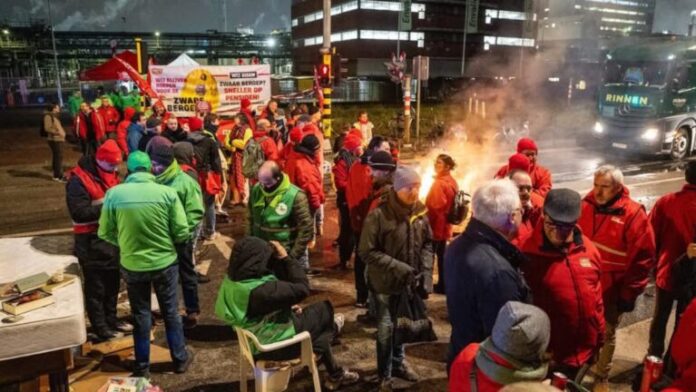
Railway unions began a three-day strike on November 24. On November 25, all public services joined the struggle, and on November 26 the rest of the sectors followed.
Strong Participation Across Sectors
The strike was widely observed on the railways: despite a compulsory minimum service, one-third of railway workers participated. In education, 25,000 teachers went on strike — around 1 in 10 — while many others limited their action to one hour and expressed their solidarity in interviews on national television.
On Wednesday, hundreds of picket lines were set up at major workplaces, and access roads and bridges leading to the ports of Antwerp and Ghent were repeatedly blocked.
The wide participation was evident from the employers’ complaints about the economic impact of the stoppages. Striking remains a powerful weapon: once the system comes to a halt, it becomes clear who produces the added value and keeps the economy running.
Government in Disarray
During the previous day of action, the government did not even show up for the opening of parliament and the ‘state of the union’. The coalition partners were in open disagreement, and the government was in a tight spot.
Beyond the budget disputes, it faced new pressures: unidentified drones appeared over several military sites and civilian airports, causing alarm. At the same time, the EU pushed the government to use the Russian assets held at Euroclear in Brussels to fund the war in Ukraine, while Moscow issued direct threats against Belgium. A sense of crisis was growing.
With tensions rising and polls showing that the governing coalition had lost its majority, the possibility of resignation and early elections was looming.
The Movement Imposed Hesitation
Workers actions had an impact — hence the visible hesitation within the government. The social democrats and the former Christian-centrist parties, which for years maintained close ties with the two main trade union federations and still rely on their voters, began putting forward a few limited demands. These included a tax on dividends, safeguarding purchasing power, and adjustments to the pension reforms.
The size of the demonstration, combined with the government’s fragility, encouraged militants to step up mobilisation for the November strikes. The aim was to give one more decisive push — enough to throw its austerity plans into the bin.
At the same time, the right-wing parties N-VA (New Flemish Alliance- moderate nationalists) and MR (Reformist Movement- liberals) were also divided on the way forward.
- N-VA wanted cuts in expenditure, selective tax increases, and indirect savings through reductions in pension and health insurance rights.
- MR, on the other hand, rejected any new taxes outright and demanded even deeper cuts in social security. Abolishing the automatic wage indexation system — even partially — was also on their agenda.
Government Paralysis and Sudden “Resolution”
After a hearing with the king, the prime minister gave himself 50 days (until Christmas) to reach a budget agreement. Afterwards, things went quiet for a long time — except for the defence minister’s request for funds to counter drone threats.
Then, suddenly, the government held a leadership meeting on the eve of the union actions. Early Monday morning, the coalition announced that it had reached an agreement on a multi-year budget.
Did the government hope to weaken or stop the actions by presenting a firm and united stance? The opposite happened. The announced measures actually increased workers’ willingness to fight. One of the key elements fueling anger was the plan to introduce a ceiling on the index system (the mechanism that automatically adjusts wages to inflation) in 2026 and 2028. After the theft in pensions came the theft in the index.
The government justified the new ceiling by claiming that automatic wage increases favour higher incomes, while inflation affects everyone equally. On this basis, they decided that the index mechanism would only apply up to a certain level — but the ceiling was set extremely low:
- up to €4,000 gross salary for workers
- up to €2,000 for pensioners
This means that a very large section of the working class will be directly affected.
The social democrats and the centrist parties accepted this attack in exchange for a small increase in the tax on securities accounts, from 0.15% to 0.30%. They even celebrated this, arguing that the indexation system “still survives”!
Many militants see clearly what this government is and how much its policies will damage their living standards.
A Package of New Burdens for Working People
Beyond the index ceiling — which effectively means a wage cut — the government is also increasing taxes and VAT on energy prices as well as on leisure activities such as cinemas, amusement parks, museums, and fitness centres.
The prime minister added that more is coming. “This is not the beginning of the end — perhaps it is the end of the beginning,” he said.
Many workers are ready to continue taking action.
However, the unions lack a broad mobilisation plan based on a clearly developed alternative around which sustained action could be organised. For now, they limit themselves to general statements like “the strong shoulders must also bear the burden,” expressed mainly in TV debates and newspaper interviews.
The Bourgeois Parties Have No Way Out
The new left-wing party PVDA–PTB (Workers’ Party of Belgium- a mass “new left” reformist party), which does present concrete alternatives, makes its presence felt mainly in parliament rather than through wider mobilisation.
The government won a confidence vote on Friday, 28/11, but all of its plans still need to be turned into legislation and approved by parliament.
The anger that exists today — and the clear willingness to take action — must be turned into discussions about mass mobilisation campaigns in 2026, built around a clear working-class alternative. For this, the formulation of an anti-capitalist programme is essential.
The bourgeois political class itself sees no clear exit from the crisis. There are limits to what can be cut at the federal level. They refuse to touch military spending, interest payments on the debt, the police or the judiciary. The biggest federal expenditure is social security — but they fear the backlash if they launch a frontal attack on it.
Some politicians therefore suggest that savings should be made by the regional governments and that “it is time for a new state reform.” This idea is reinforced by the ongoing crisis in Brussels, where — 500 days after the elections — there is still no regional government or budget, leading some banks to start refusing loans.
In this situation, there is a real danger that the political class, instead of confronting the clear class divide between workers and capitalists, will try to divert attention toward conflicts between regions.
The labour movement, which has just demonstrated its strength through unity, must not fall into this divide-and-rule trap.
The focus must remain on defeating the government’s anti-worker plans, even if it means accelerating its crisis and bringing it down.