


Thereza Powers
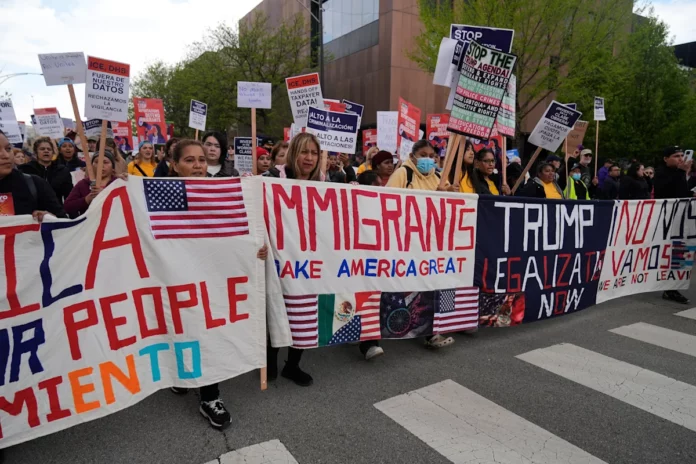
This year’s May Day saw significant mobilizations and marches, some school closures, and even small examples of strike action. Yet, many activists had reason to hope for a much more powerful action to confront Trump and his right wing, authoritarian agenda. The enormous victory against ICE after the January 23rd mass strike in Minnesota set a high-water mark for resistance. The day of “No Work, No School, No Shopping” set a profound example that inspired national discussion about next steps to fight Trump and ICE’s gestapo tactics. I counted myself among those looking to make May Day 2026 a day to build on the Twin Cities momentum.
I am an elementary Special Education teacher, proud Chicago Teachers Union (CTU) member, and elected school delegate. In Chicago, we had ICE in our streets kidnapping neighbors just months before they descended on the Twin Cities. Many schools, including my own, had spent the fall building school-based ICE response networks that included safe passage shifts and Know Your Rights trainings.
Leaders of the CTU joined the January 23rd mass strike in the Twin Cities in person. They pointed to it as a positive example to build on and later announced plans for a May 1st “Day of Civic Action.” As put forward at the March House of Delegates (HoD) meeting, the CTU’s monthly delegate meeting, the Day of Civic Action implied shutting down the city and a call for “No Work, No School, No Shopping” to be joined by educators and families.
What actually happened in the schools was quite limited. Important awareness was raised around the significance and history of May Day among educators, students, and the Chicago school community. But there was no shut down. No disruption of business as usual. And no direct challenge raised to Trump’s racism and warmongering.
News outlets reported staff absences just a bit above average for the week. Student attendance remained normal, with the exception of high schools reporting 72% attendance compared to the previous Friday’s 75%. While students from around 40 schools participated in field trips to community hubs or to the main rally in Union Park, all schools remained in session. Some schools organized assemblies or resource fairs and some teachers gave lessons in their classrooms, but many did not participate at all. After weeks of discussion and planning, May Day in Chicago, as it was initially conceived by CTU leaders and approved by CTU rank-and-file delegate leaders, was essentially a flop.
Why did the Day of Civic Action underperform so much? Answering this question is important for class struggle unionists like myself and those across the country.
CTU’s Political Influence Fails to Cancel Classes
In my opinion, May Day could have been a disruptive, powerful action. The movement had slowed after the victory against ICE in Minnesota, but with prominent unions like CTU taking the lead, there was an opportunity to keep up the pressure. We could have shut down the city and led the way for workers across the country. I think the reason it fell short was largely due to the weakness of the CTU leadership’s chosen strategy of relying on leveraging Democratic Party politicians that the union helped elect.
CTU leaders initially seemed to have secured the support of former CTU teacher and union staff organizer, Mayor Brandon Johnson and the Johnson/CTU-influenced School Board. If they signed off on a “Civic Day of Action,” the union would not have to take full political responsibility for the shut down or debate the issue fully internally. In the lead up to the Day of Action, Mayor Johnson continuously said, “May 1st is happening.”
As every class struggle unionist knows, progressive Democratic politicians are unreliable allies even in the best of times due to their conflicting tie-ups with big business. As May Day approached, these political leaders flinched and capitulated. It’s not clear if Johnson and the School Board genuinely planned to shut down schools and then backed down due to pressure, or if they had planned to water things down all along. This story remains unreported. Either way, absent action by city and district officials, CTU was left in a corner of our own making. The union struck a Memorandum of Understanding with CPS to allow for May Day lessons and trips, but there was no plan B for “No School, No Work.”
May Day showed the limits of CTU’s political influence. Unions should of course make use of politicians’ support where they can get it. However, far too often the CTU leadership of President Stacy Davis Gates and Vice President Jackson Potter uses the strategy of leveraging friendly Democrats as a one-size-fits-all shortcut. Our power is not primarily in dues money flowing to electoral campaigns, but in our power as vital workers with social authority and the means to shut things down. In their consistent focus on political influence, CTU leaders neglect the tools of rank-and-file organizing and class struggle. Make no mistake, members are able to see that they are being made into observers or passengers, rather than participants, in our own union’s action. We need more confidence in our independent worker power.
I want to be clear that I am making a different critique of CTU leadership than the Illinois Policy Institute or The Chicago Tribune. There is also a minority of more conservative members, very active on social media, who in many cases echo pro-business propaganda calling CTU a “political machine.”
Working people absolutely have a right to our own representation, and unions should be involved in electoral politics. But union members need to be aware that even where we are decisive in a winning campaign, the capitalist class can bring enormous pressure on any representative. They have the advantage in the halls of state power. As it stands, CTU’s strategy exaggerates the strength these politicians give us, to the point that an over-reliance on arrangements with politicians is actually harming our union’s democratic vitality and fighting capacity.
By pushing for May Day action, CTU compared favorably with most of the rest of the labor movement, which let the moment pass by. CTU leaders consistently prepared members for May Day for months and came up with member-led structure tests that steadily built this support among the rank-and-file. The problem? The overall strategy hinged entirely on friendly political representatives facilitating the union’s actions, rather than the union guaranteeing it through an independent commitment of its class power.
Many thousands of members were prepared to shut down the schools on May 1st. Many dozens of delegates like myself prepared for this school by school. Yet, when the politicians’ support dissolved… so did our May 1st “No Work. No School. No Shopping.” Instead, we had more work planning in-school civic lessons, and many frustrated, dejected, and confused members.
Organizing for the Day of Civic Action and Its Opponents
From the view of the union’s membership, these events unfolded in a confusing fashion. The discussions between the CTU leadership and powerful city and district officials were not transparent to us, so following the public twists and turns had many members feeling twisted into knots.
To their credit, CTU leadership began laying groundwork for May Day as early as the February House of Delegates (HoD) meeting. At this meeting, delegates were given a poster to bring back to our schools for members to sign as a “structure test.” The poster read: “Our school is ready to: Protect our students, Tax the rich to fund our schools, Defend our democracy, Fight back on May 1st.” The “fight back” was still not totally clear, but many members in the schools signed on in agreement to doing something.
At the following March HoD, CTU Leadership brought a resolution on May 1st and the Day of Civic Action. Delegates voted overwhelmingly in favor after a short discussion. The delegates that I spoke with and members who were following events were under the impression that we were calling for a day of non-instruction so that teachers, students, and families could attend the big May Day rally.
All members were mobilized to sign a petition demanding Mayor Brandon Johnson and the Board of Education declare May 1st a “Day of Civic Action.” Although the Civic Action resolution passed the HoD overwhelmingly, the petition itself ultimately gave the Mayor and the Board the power to define the fate of May Day, leaving delegates and members alike with vague guidelines for action.
In March and April, national corporate newspapers ran oppositional editorials and reporting, and public debate intensified. Nonetheless, in early April it seemed like we were just waiting for the gears of the decision-making process to turn. At that time, the Board of Education held a closed session and it was shared that a straw poll indicated support for a Day of Civic Action. Following this, a rumor spread that Johnson appointed interim CPS CEO Dr. Macquline King was on board. So far, so good.
But just hours after buzz around the King rumor hit our schools, Dr. King walked back her perceived agreement in an email to all CPS staff where she wrote, “…my position is to maintain May 1 as an instructional day. As a career educator, I believe that every minute in the classroom is vital for students. My position has been consistent and has not changed.” Member activists felt concerned, and CTU leaders did not have concrete answers.
CTU leaders responded by mounting several lines of public rebuttal. But despite the public air war, May Day appeared shaky. It became a hot topic among the rank-and-file in the schools. Rumors swirled around different news outlets, internal CTU communications, CPS emails, and social media. Feelings of whiplash and a negative view on May Day began to circulate among some members, who complained that they were being forced to participate in something political they didn’t themselves vote for, or that the union had planned poorly and made their life uncertain.
Nonetheless, if the union took action after all, I believe a large majority of members would have been ready to go. It was just that time was running out. Discussion swirled – What the hell are we doing on May Day? Are we calling off? Is this a one-day strike? Are we holding out and waiting for Mayor Johnson to cancel school? What is the plan?
We got an answer at the House of Delegates Meeting on April 15th, where I for one was surprised to be given three different options to take back to membership: 1) Coordinate Field Trips to community hubs for students to participate in a day of civic education around May Day; 2) Host a “Day of Civic Action” at your school; 3) Take a Benefit Day. CTU Leadership continued to blame CPS for all confusion and reiterated that delegates needed to be flexible and have a plan in case school was not cancelled. They said they were working towards an agreement with CPS, but they didn’t have concrete details or full terms. At this point, schools were instructed to “choose their own adventure.”
May Day in Chicago: More Work for Educators, School in Session
Choose your own adventure?! At the April 15th HoD, hope was kept alive that CPS would relent. However, CTU leadership had effectively retreated and the Civic Day was redefined. Members struggled to keep up and understand the shift. “Choose your own adventure” meant that some schools were going all in to plan field trips or days of action, but it also meant that many schools were off the hook to do nothing at all, plus everything in between.
With just the Memorandum of Understanding in place, obstructive administrators and CPS had the ability to water down our school plans. They skirted around the language, denying field trips and avoiding required paperwork. Rather than uniting members around a common struggle to fight back against the right-wing dismantling of education and its funding, CTU’s failure to secure a non-instructional day siloed May Day actions inside the schools. It also undermined delegates and activist members that had spent a lot of effort convincing members to get behind bold action. May Day as it was initially envisioned and discussed in Chicago was a bust.
Ultimately, many schools across the city participated on May Day in ways that depended on the activists within the school, the willingness of administration, and buy-in from individual communities. Some students went on field trips to CTU Headquarters, Rainbow Push, and BUILD; some high schools held assemblies and teach-ins for their students and neighboring schools; schools hosted their own “Days of Civic Action” with community clean-ups, resource fairs, and mini-marches around their buildings; and some teachers used a May Day Curriculum to teach lessons in their classrooms about the history of May Day. Any action taken required a lot more work and flexibility from teachers to make it happen, but in the end, it raised consciousness among educators and in school communities. Yet, CTU’s bold May 1st strike threat, which had rattled Chicago’s ruling class, had been withdrawn, and this was a success for the rich and powerful.
An Alternative Class Struggle Approach
CTU leaders should have decided on a solid strategy for actual disruption. This might have come in different forms, like an attempt for a sick-out or an actual strike vote, which would have likely been ruled officially unlawful like many great union struggles of the past. There would have been a contentious and robust debate over this in the rank-and-file, with no guarantees of success. But this debate, on clear terms, could have been educational and empowering. Perhaps these proposals may have even lost in a democratic vote, something CTU leaders surely feared. But of course, we did not succeed in having a “No School” May Day through Mayor Johnson either.
The CTU’s approach to May Day was just one example of the leadership’s disorganized approach and lack of transparency connected to the political influence strategy. This conduct has been typical since close ally Johnson ascended to Mayor, but the problems go back further to a longer-term strategy of placing far too many eggs in the basket of trying to game politics in the halls of the state. These maneuvers are then brought to the membership, rather than organizing power with us.
The take away is as Jane MacAlevey famously quipped: there are no shortcuts. To win, we have to build and rely on the massive power we possess as educators in the schools to galvanize school communities, to unite with other workers, and to disrupt and resist. We hand this power over to others at our peril.
A class struggle approach genuinely involves the membership in deciding how to use the union’s independent collective power. It allows for multiple proposals, differing opinions, intense debate and discussion, and vibrant democracy. The strategy understands capitalism does not grant us easy victories. We must commit to building a wider multiracial working class movement that understands the need to challenge the normal functioning of capitalism to force change.
The CTU Dues Restructure: Leadership Loses a Referendum on their Struggle Strategy
At the May HoD, each CTU officer report championed our May Day action and characterized it as an impactful success. Some members would agree, but for many, May Day was an unpleasant disappointment that raised many doubts about the union and leadership. For me, the HoD was cognitive dissonance. As a collective leadership we weren’t grappling with the total result. I felt it was tragic that we ended up with so much disappointment and unease when there was a huge possibility around May Day and a great deal of work was put into organizing.
How can the post-May Day member sentiment be gauged? Interestingly, the May HoD also initiated a new democratic procedure in the union. In addition to preparing for other end-of-the-year votes, delegates were also responsible for organizing discussions and a vote on a proposal to restructure the dues of CTU, held on May 20th and 21st. CTU leadership brought forward a Constitutional Amendment to restructure the dues in a more equitable way, proposing all members to pay 1.75% of their base hourly salary instead of the current flat rate.
Delegates were first informed about a possibility to raise dues back in January, but it did not feature prominently at meetings until March. When the official language of the Constitutional Amendment was brought to delegates to discuss in April, I was overwhelmed. It was a lot to consider alongside the May Day confusion. And CTU leadership added an additional question to the mix: another new clause to the constitution about exhausting all union structures before taking CTU to court. All things considered, I for one was hesitant to give more in dues money to an unclear political strategy, not to mention needing to convince my colleagues why this was critical.
Ahead of the all-membership vote, CTU and staff organized one of the biggest member engagement campaigns I have seen in the union. Leadership explained the dues change from a number of different angles: we need money to fight back against Trump and the right wing, to pay for organizers to defend our contract wins, for the upcoming Elected School Board races, and for the inevitable fight to defend against school closures. Given this long list of reasons which basically summarized the union’s political outlook, the vote acted as a referendum on the leadership’s approach and was seen that way by members I spoke with.
Of course, there was a lot of opposition from more conservative parts of the union membership which could be seen all over Facebook, but ultimately this proposal was not endorsed by a much wider part of the general membership. At the time of publishing, we are still waiting for the citywide breakdown, but in initial communication from CTU leadership, they shared that with approximately 80% of schools counted, the trend was roughly 60% of members voting against – a significant defeat. By comparison, the CORE leadership was reelected with 64% of the member vote in 2025.
For me, the vote does not leave any doubt that CTU is still a majority progressive, fighting union. Even despite inflation pressure on members, a dues increase might have passed if the proposal were tied clearly to empowering activism. But given the context, many members were not inclined to send the union more dues money and instead, sent a message of frustration. I think the vote result is fairly described as an example of the growing disconnect between CTU leadership and the rank and file.
Equitable dues could be the right step for the union down the line. But for our union and the broader working class to be stronger in the righteous fights that CTU leadership correctly identifies are coming, money is not necessarily decisive. Truly powerful collective action can best be measured in the risks, time, and sacrifices members make to build it. The rank and file need to push CTU leadership to take a class struggle approach that features democratic meetings which include us in the fight, rather than demand members join action with no critique of tactics and strategy.
We need a vision of working-class power and a clear, determined organizing strategy to bring everyone in. More dues money for organizing could possibly help this. But it’s the self activity of the members that is our true strength. If money is simply used to double down on a limited strategy to contribute to more political campaigns, we are no closer to being prepared to fight like we need to be fighting.
That fight is not letting up. In recent days, Chicago educators have faced notice that CPS expects to conduct the largest set of layoffs in years. Covid money is drying up and Trump is at war with public education. School closures are back on the table. Principals have said these cuts only compare to those of the early 2010s, coming out of the Great Recession. The fight to tax the rich to fund our schools is urgent.
I am proud to be a member of the CTU and grateful to be in a position to engage in genuine collaboration about how to work towards a fighting strategy in our unions. I hope that leftists and unionists across the country will also try to draw lessons from our May Day experiences and think of how we can empower our unions and raise up the level of resistance against Trump and the capitalist billionaires ruining the country and the planet.