

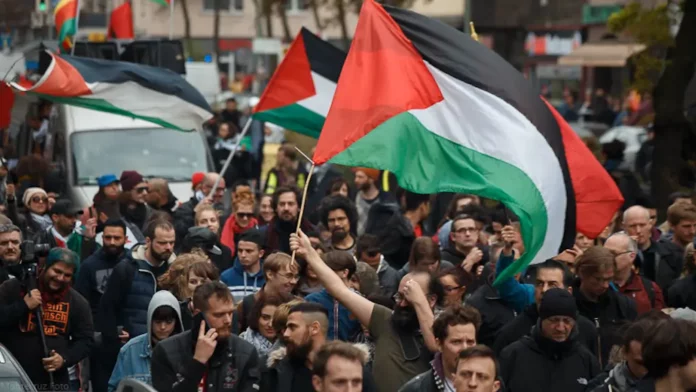
A very important discussion on Palestine was organized at this year’s Athens Anti-Racist Festival (July 5-6-7). The topic of the discussion was “Palestine and Lebanon: War and Resistance.” The invited speakers were:
- Ofer Cassif, a member of the Communist Party of Israel and a member of parliament (elected with Hadash – an electoral coalition centered on the Communist Party of Israel). Both the CPI and Hadash have Palestinian and Jewish Israeli members.
- Sholafa Mahoul also a member of the Communist Party and a key figure in the “Alliance for Peace” in Israel
- Mihiar Ektami, president of the Palestinian Workers’ Union in Greece
- Sotiris Roussos, professor at the University of Peloponnese, Greece.
The moderator of the discussion was Yiannis Albanis.
During the discussion, there was a strong reaction from some individuals, concerning the speakers and their political positions. For a moment, it seemed that the discussion was in danger of being completely derailed. We will refer to these below.
The main points of the speakers
Ofer, Sholafa and Mihiar spoke about the situation of the Palestinian people, about the genocide in Gaza and the ethnic cleansing in the West Bank, about Israel’s expansionism and the occupation of new territories in Lebanon. They reported that up to 70% of Gaza is now under Israeli occupation, that the population of Gaza, close to 2 million, is now forced to live on about 1/3 of the land they previously lived on, and living at daily risk from attacks by the Israeli army, from hunger, lack of shelter, sewage and rodents, due to the destroyed infrastructure.
They explained that there are specific plans to expel hundreds of thousands of Palestinians from Palestine. They recalled the Nakba (meaning “catastrophe” or “disaster”) of 1948 – the war that exiled almost 1,000,000 Palestinians to create the state of Israel, and that the new generation is living its own Nakba today. They spoke about the struggle being waged internationally against the murderous Israeli state; they referred to the battles they themselves are fighting within Israel, facing daily repression and fear for their lives; but they also emphasized the fact that they are not deterred, they will continue the common struggle of Israeli Jews and Palestinians for peace, democracy, mutual respect, equal rights and an independent Palestinian state.
The speakers explained clearly the need to distinguish between the Jewish/Israeli people on the one hand and the Zionists on the other. They emphasized that the enemy is not the Israeli people, it is Zionism. And that there are many Israelis and Palestinians who are fighting together for a peaceful future and peaceful coexistence.
And indeed, beyond Hadash, there are over 70 organizations and movements fighting for this purpose, and almost all of them participate in the Alliance for Peace (“The Peace Partnership” created in December 2023) and together they carry out very important mobilizations.
Sotiris Roussos explained, among other things, that the reason why the Oslo Accords –the most serious attempt in history for a solution to the Palestinian problem– were overturned was the strategy of a part of the Israeli ruling class, represented by the far right and Netanyahu, for the creation of Greater Israel – which is precisely what we see today developing before our eyes with the three-year war that began in October 2023.
Main points
The way in which the debate developed at the event opens (again) a series of important issues.
First, whether there is a resistance movement in Israel against the genocide and how important it is. Second, what is the policy that the Left must follow if it wants to contribute to peace in the region and to end the seemingly endless bloodshed. And third (as we will see below from the reactions of some individuals from the audience), how the necessary dialogue should be conducted within the ranks of the movement for Palestine on these issues.
It is not possible to enter here into an exhaustive analysis of the Palestinian issue within the framework of a short article – for this reason, at the end of the article we provide some links to older analytical material.
The underestimation of resistance within Israel
What needs to be emphasized from the outset, is that most of the anti-capitalist Left completely underestimates the role of the resistance that exists within Israeli society and within Jewish communities internationally.
The presence and positions expressed by comrades Shulafa and Ofer from Israel have been very useful in helping to counter this imbalance.
In Israel the protests against the genocide and the occupation are ongoing and range from a few hundred to several thousand, in a climate of enormous polarization, state-terror, physical attacks, layoffs, etc, for anyone who defends the cause of the Palestinian people. One can get an idea of the protest mobilizations by visiting the page of the Alliance for Peace, as well as the websites of the Organizations that participate in it. In addition, there were cases where hundreds of thousands took to the streets against the Netanyahu government (as happened, for example, in the general strike of August 2025)[1]; mobilizations, where hundreds of Israeli Jews and Palestinians were arrested. And although there were possibly different views regarding Palestine, there was a clear demand to stop the war in Gaza. The importance of such mobilizations is downplayed by the bulk of the anti-capitalist Left. Some organizations have gone so far as to claim that there is no question of class divisions in Israel, all Israeli people are responsible for what is happening in Palestine, Israelis do not have the right to have their own state, etc.
These are serious errors in the analysis of the situation, that lead the positions of much of the Left to a dead end.
Class approach
In addition to refusing to see the objective reality, these approaches reject a class analysis of the Palestinian issue, which, for the Left, should be fundamental.
Every national problem has a class dimension. Without understanding this, the Left has no way of proposing a way forward to the national problems erupting across the globe.
Capitalism’s main method of attempting to “solve” the serious national problems of our time is war, which, however, does not solve the problems, but only transfers them to the future in another form. Let’s look at the Greek-Turkish question, the Cyprus problem, the problems in the Balkans, Ireland, the war in Ukraine, etc., etc. – the list of examples is endless. The Palestinian question is of course at the top.
The class approach explains simply that peace and the solution to national antagonisms and conflicts can only be provided by the struggle of peoples, on the basis of class solidarity, friendship and cooperation. However, this important truth is mostly lost, to a Left that is in crisis and retreat.
This in essence means a struggle for a socialist perspective because only in this way can national issues –as well as all the other major problems that capitalism generates and reproduces– be solved.
The methods of struggle
These important questions are related to the methods of struggle of the Palestinian people.
A large part of the anti-capitalist Left, extol the methods of Hamas (and other smaller guerrilla groups), and particularly so the October 2023 offensive. They believe that such tactics will bring a solution and that Hamas (and other smaller organizations) is the exponent and protagonist in this confrontation.
On this basis, in essence, they reject a class analysis.
The reality however is that the Palestinian national problem cannot be resolved in favor of the Palestinian people with the methods used by Hamas.
Let’s look at things, concretely, as we have experienced them in recent years. The new war that began in October 2023 with the Hamas attack, has a clear winner: Israel – however unpleasant this conclusion may be. Israel occupied most of the Gaza Strip, expelling the Palestinians, expanded settlements in the West Bank, expanded into Lebanon, seized new territories in Syria and developed special relations of mutual support with the Druze and Kurds of southern and eastern Syria respectively.
This is the fourth major war between Israel and the Palestinians (and their allies) – the others were in 1948, 1967 and 1973. There have certainly been others in between, of lesser intensity. All of these wars led to one thing: new tragedies for the Palestinian people, new defeats.
This simply describes the (very unpleasant) objective reality, from which the anti-capitalist Left must draw conclusions.
However, this does not mean to have a pacifist approach, it does not mean submission to the great powers and illusions that they will solve the problem!
It does not mean rejection of armed struggle!
It means adopting class analysis and integrating armed resistance within the framework of the class approach.
The right of the Palestinians to arm themselves and resist in order to defend their land is non-negotiable. However, this is different from the massive attack on Israeli civilians, as happened in October 2023 with Hamas as the protagonist, which had the effect of rallying the population of Israel behind the reactionary government of Netanyahu in the name of “security” and “protection”.
Let us therefore be clear: the disagreement is not about the right of Hamas and other armed Palestinian organizations to arm themselves and to fight, it concerns how this right is exercised.
It does not concern the existence of Hamas as an armed organization, although we have a direct disagreement with its Islamic character as well as the Islamic –reactionary and theocratic capitalist– regime that it wants to install. Our disagreement concerns its tactics – such as the invasion of a youth festival and the cold-blooded execution of hundreds on October 7, 2023.
And the reason for this is not moralism, although there is certainly a moral dimension in cases of mass attacks by armed groups on civilians. It is primarily political as it undermines the struggle of the Palestinian people for their rights to their land, to the creation of an independent state, to the return of the refugees, etc. It leads to new defeats for the Palestinian people.
Is despair an alibi?
It is certainly understandable that after 78 years of persecution, colonial settlements, exceptionally harsh repression, arbitrary mass imprisonments and murders, this can lead to “excesses” as despair inevitably takes hold. However, when these “excesses” are exploited by the enemy to level Gaza, to cause genocide, to exterminate the population in every possible way, to condemn it to malnutrition, to lock it in a “cage” of a few dozen square kilometers, then the assessment must be made: did the attack of October 7th deliver what was expected, did it bring progress to the struggle of the Palestinian people or did it lead to a new military defeat?
On top of that there was a political defeat for Hamas itself, as on July 7th 2026, Hamas declared that it was resigning from the Gaza government, within the framework of the ceasefire proposed by Trump in October 2025 and accepted by Hamas.
When the result is a defeat, the Left has a responsibility to call things by their name, to assign responsibilities and to draw conclusions about how the movement can go forward.
In practical terms, a class approach for the Palestinian resistance movement would mean (for a more thorough analysis see references at the end of the article):
- Equipping and militarily training the entire Palestinian people and not just the Hamas militias (and other smaller armed organizations).
- Organization of the armed people into people’s militias, under fully democratic structures; which means, among other things, the right to have a decisive say in decision-making.
- Positive response and active participation in every call/effort/action that brings together and builds bridges between the Palestinians of the occupied territories and the peace and fraternity movements that are active within Israel and that support the creation of an independent Palestinian state.
- Recognition of the right of self-determination for both nations – that is, both Palestinians and Israelis to have their own independent national state if they wish. If conditions for coexistence within a single state can be created, even better. This should include the right of refugees to return to their homes.
- Fight against nationalism, racism, apartheid and the far right, which means fight against capitalism, and for a socialist perspective for both Palestinian and Israeli workers and youth.
Aggressive attitude from audience members
As important and interesting as the positions of all four speakers were, the discussion organized at the Anti-Racism Festival faced a strong reaction from three young men who stood up from the audience and interrupted the discussion with loud voices, demanding to speak because they are “Palestinians from Gaza” and that “Israelis should not be allowed to speak”.
The whole event was in danger of being blown up, but after the moderator’s patient efforts and the assurance that they would be able to speak later, the three agreed to let the proceedings continue.
When they took the microphone, these individuals erupted into a frenzy, with one central theme: “Israelis have no right to speak”.
Of course, Mihiar is a Palestinian living in Greece. And Shulafa is 100% Palestinian, as she explained to us – her family had become refugees in 1948, when she was still unborn, and later returned to Israel. That didn’t matter to the angry young men – one even accused Sulafa of having an Israeli passport (like almost all Palestinian citizens of Israel) and therefore being Israeli. Ofer Cassif is Jewish, has been imprisoned four times for refusing to serve in the Israeli Army in the occupied territories and has suffered persecution precisely because he defends the Palestinian cause.
One of the three men took the microphone and, putting it in the mouth of each of the speakers, demanded that they shout “Free Palestine”! No one hesitated to do so – as if there was anyone there, either among the speakers or in the audience, who did not support a Free Palestine. Another one of the three individuals called on the crowd to leave the event – when the crowd did not leave, he stayed too.
The main complaint of all three was that the event did not revolve around the “resistance”, meaning the armed struggle of organizations such as Hamas (and others), and why the floor was given to Israelis.
In their closing remarks, the speakers addressed the points raised by the three angry young men:
Ofer replied that he shouted “Free Palestine” in the Knesset (the Israeli parliament), just as he shouted that the Israeli army was committing war crimes, while he supported referring Israel to the International Court of Justice on charges of committing genocide. For these, Ofer received sanctions, while he constantly faces persecution and threats from the regime.
Sholafa told them that it is very easy to point fingers from the safety and comfort of a European country. She explained that she, unlike them, does not know whether tomorrow she will be in prison or dead with a bullet in her head.
Mihiar explained that the positions of the three young individuals reflect an emotional rather than a rational response: the fact is that the Palestinian people need allies everywhere and especially within Israel, who will fight the policies of the Zionists. Otherwise, as he said, our movement is being led to suicide.
Other people from the audience also intervened in the discussion. We highlight the position of Nikos Giannopoulos, from the Network for Social and Political Rights, who referred to the history of the 999th battalion of the German army (Strafbataillon 999), which defected and fought on the side of the Greek liberation army, ELAS, during the time of resistance to the German occupation in World War II. Should the Greek resistance have said “no, because you are Germans”?
Xekinima (ISp Greece) also intervened, explaining the importance of the struggle of the comrades of the Communist Party who are fighting inside Israel against the policies of their government and for the common struggle of Israeli and Palestinian workers.
Positive and negative
We must recognize the reality, that there are different views within the ranks of the Palestinians as well as within the international solidarity movement. How can these different opinions be discussed and how can the movement move forward?
Clearly, these differences cannot be addressed with screaming, or by interrupting speakers and demanding that those who have a different opinion (or those of a specific national origin) be silenced. Slogans like “Israelis have no right to speak”, are emotional but lack political seriousness, especially when addressed to people who face repression and have been in prison because of their support for the Palestinian people’s rights.
The different views on the Palestinian issues could and should have been discussed in a substantive manner, with comradely debate and political arguments, with the aim of drawing conclusions.
The event, while controversial, allowed for some clear positives to emerge including getting to know important activists within the peace movement who fight and support the rights of the Palestinian people within Israel. Such acquaintances are important both for the Greek and the international movements. The message that went to many attendees was that there are significant forces in Israel, who are a minority of course, but who are fighting hard and with self-sacrifice for Palestinian rights.
As “Xekinima”, we have strengthened our relations with these fighting comrades and are already discussing their presence at our next events/discussions.
Related articles:
● Palestine: Can the Trump plan bring peace?
● Gaza: war, ethnic cleansing, genocide – is there a way out?
● The Internationalist Standpoint’s Position on Palestine
__________________