

What has been unfolding in Turkey over the past weeks is not a loose sequence of isolated incidents. The bans announced ahead of the NATO Summit in Ankara, mass detentions, the rounding up of stray dogs, the reorganisation of urban space according to security protocols, judicial intervention in the main opposition party and police repression against labour struggles should all be read as parts of the same political tendency. That tendency is the deepening militarisation of the regime.
Militarisation here does not simply mean the growing visibility of the army in politics. It refers to a broader mode of rule: the suspension of public space on security grounds, the treatment of social opposition as a “risk”, the transformation of the judiciary into an apparatus for reorganising the political field, and the management of economic crisis through police power and administrative decree. The regime narrows the space of citizenship, surrounds dissent with preventive security measures and codes social discontent as an internal threat to be suppressed.
Governing Through Security
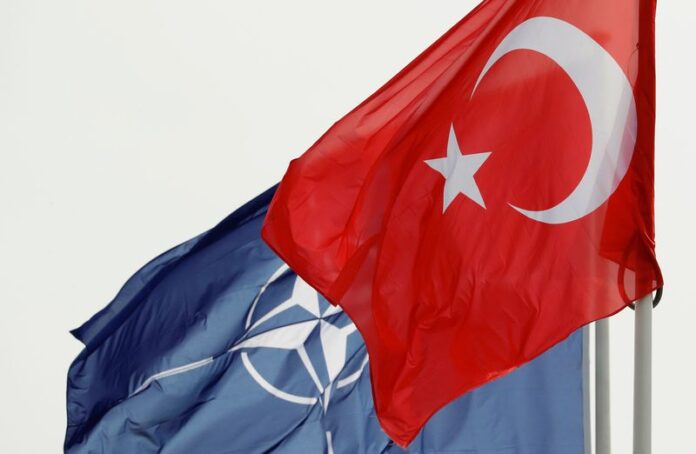
The NATO Summit to be held in Ankara on 7-8 July 2026 functions as a lens through which this process becomes magnified. Turkey has been a member of NATO since 1952. The Ankara summit carries particular significance in the context of the alliance’s new “defence” spending commitments, military industry investments, the war in Ukraine, tensions in the Middle East, and the architecture of European security. Yet the summit’s domestic political effects go well beyond diplomacy. As the capital is transformed into a security stage for an international military alliance, citizens’ rights to hold meetings, demonstrations, press statements, sit-ins, hunger strikes, information stands, and to put up posters and banners have been banned from 28 June to 10 July.
This ban is not merely a summit security measure. The city itself is being politically emptied. The street is no longer treated as a place where citizens walk, speak, assemble and make claims. It is turned into a sterile corridor for state protocol. The measures taken in the name of security extend deep into the texture of social life. The rounding up of stray dogs from summit routes is one of the most striking signs of this logic. For the regime, the stray dog, the image of poverty, the protest banner, the teacher on hunger strike, the journalist, the student, the lawyer and the ecological activist are all placed within the same logic of regulation: elements to be rendered invisible, removed, silenced.
The detention of more than 200 people in Ankara ahead of the NATO Summit revealed the harder face of this “security” regime. Human rights organisations reported that those detained included political activists, lawyers, an academic, a journalist and people working in the field of LGBTQ+ rights. The authorities presented the operations under the heading of “counter-terrorism”. In Turkey, this label has long been used broadly to repress political opposition, especially left-wing, Kurdish, feminist, ecological and LGBTI+ movements. The pre-summit operations are the latest link in this chain.
Judicial Intervention to the Main Opposition
Another dimension of the militarising regime is the judicial intervention in the Republican People’s Party, the CHP, Turkey’s oldest political party and today the main opposition force. Its success in the 2024 local elections, when it came ahead of the ruling party and won major metropolitan municipalities including Istanbul and Ankara, created a new field of risk for the regime. In 2026, a court annulled the CHP congress on the grounds of “absolute nullity”, removed the elected party leadership from office and reinstated the former leadership. This amounted to direct judicial intervention in the internal life of political parties.
“Absolute nullity” may sound like a technical legal term, yet its political consequences are far more decisive. Through a court ruling, the internal functioning of a political party is reshaped. Party bodies formed through elections are pushed aside by judicial decision. This cannot be seen simply as an internal crisis within the CHP. It signals the restriction of political life in Turkey not through the will of voters, but through administrative and judicial intervention. From the appointment of trustees to elected municipalities to lawsuits against opposition politicians, from the imprisonment of journalists to the annulment of party congresses, the same line is visible: an attempt by the regime to make democratic competition manageable.
The link between this wave of repression and the economic crisis is clear. Wage labour in Turkey is going through a severe cost-of-living crisis. The official minimum wage has fallen below the hunger threshold calculated by workers’ confederations. As the costs of food, rent, transport and healthcare continue to rise, millions of people cannot meet their basic needs despite working full-time. The erosion of the middle class, the spread of youth unemployment and the rapid proletarianisation of professional occupations are among the defining social dynamics of this period.
Teachers’ Hunger Strike
One of the most visible areas of this proletarianisation is private-sector teaching. In Turkey, private schools charge high fees to students, while many teachers working in these institutions face low wages, insecure contracts, long working hours, bullying and intimidation and the constant threat of dismissal. This is why the demand for a “base salary” has become central. The base salary demand means that teachers in private schools should not be condemned to wages lower than those of public-school teachers. Teachers are calling for this right to be secured by law, for their employment rights to be improved, for humane working conditions to be established, and for the grievances caused by the interview system used in public teacher appointments to be addressed.
The hunger strike launched in Ankara by the Private Sector Teachers’ Union should therefore not be seen merely as a dramatic form of protest. It has become a stark political scene exposing how teachers’ labour is devalued within the education market. The teachers on hunger strike say that promises made to them have not been kept, that no real interlocutor has come to the table, and that democratic channels for demanding rights have been cut off by police intervention. When teachers attempted to have a press statement in front of Parliament in the first days of the strike, they were met with police violence; union executives and members were detained. On the fifth day, two teachers were taken to hospital after their blood sugar levels dropped, revealing the bodily risks of the strike. The hunger strike has now passed its tenth day. Dozens of teachers, together with their families, continue the hunger strike in front of their union building, on one of the city’s busiest streets. As the interview on this issue, soon to be published on these pages, will show, the hunger strike does not express only a wage demand. It also reveals the everyday poverty and professional degradation made insignificant within the private education market.
This hunger strike is particularly important because it shows that authoritarianism in Turkey is not limited to repression against opposition parties or journalists. The regime also treats demands from the sphere of labour as a security problem. A teacher’s demand for a decent wage tis met with a police blockade at the gates of Parliament. The demand for humane working conditions is treated as a potential disturbance of public order. The hunger strike becomes a way for teachers, already pushed into hunger, debt and precarity in daily life, to make this structural hunger visible.
Apart from the teachers’ hunger strike, mine workers marching to Ankara to demand unpaid wages, the criminalisation of ecological movements, the targeting of those defending stray animals and the accreditation barriers faced by journalists, are all parts of the same moment. The regime can no longer overcome the economic and political crisis by producing social consent. This is why more bans, detentions, court cases, police blockades and administrative decisions are being deployed.
What we are witnessing in Turkey today is a new phase of authoritarianism. In this phase, the security state, the war economy and neoliberal impoverishment converge.
The NATO Summit makes this convergence even more visible. To the outside world, Turkey presents itself as a reliable NATO partner, a regional security actor and a state with strong military capacity. Inside the country, the same state continuously restricts citizens’ right to speak, workers’ right to organise, the political activity of the opposition and the use of public space.
For this reason, the bans in Ankara cannot be read as a few days of summit security. They are the concentrated expression of the regime’s mode of governing society.
Yet this picture is not a sealed darkness. As the regime’s apparatuses of repression expand, the social map of resistance also becomes clearer. Teachers are on hunger strike, mine workers are on the road for their rights, ecological defenders are trying to protect living spaces, journalists continue to report despite censorship, and animal rights advocates refuse to abandon the streets. The militarising regime seeks to silence society. Yet in Turkey today, the street, the school, the mine, the courthouse corridor and the union doorstep are still speaking.
This, then, may be the answer to the question of what is happening in Turkey: the regime is trying to govern the crisis through security. The NATO Summit provides an international showcase for this mode of rule. Economic devastation, judicial intervention, police repression and the war economy are lined up along the same axis. Yet standing against this axis are people who hunger, march, write, organise, care and resist. The story of Turkey’s future is also being written in this vein of resistance growing under the shadow of a militarising regime.