

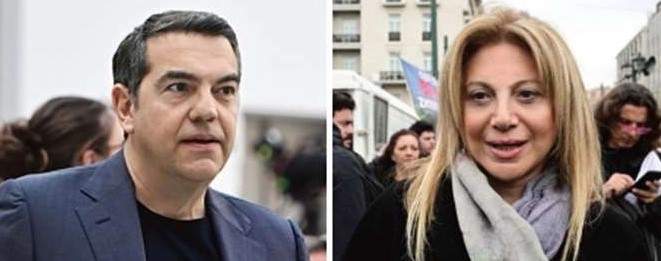
The recent polls in Greece show that the newly formed party of Alexis Tsipras (former SYRIZA leader and prime minister) is consolidating its position in second place, after the New Democracy (ND) right wing government party, which remains in the first place despite seeing its support drop due to corruption scandals, austerity and oppression. The party is called ELAS, in a disgraceful attempt to associate itself with the resistance army (called ELAS) that liberated the country from the Nazi occupation at the time of world war II.
The also newly formed party of Maria Karystianou ,”Hope for Democracy”, former leader of the mass movement that demanded justice for the victims of the Tempi train crash, polls around 10% and is between the third and fourth position. But Maria Karystianou is no longer the person who inspired hundreds of thousands of people to take to the streets and demand justice and safe public transport for all. She has become the leader of a conservative party contained within the capitalist system, with nothing new or fresh to bring to the table as many once hoped, and even adopts elements of far right rhetoric.
The comeback of Tsipras
The common characteristic between the two ”new” parties, is that both are empty of political content. The founding declaration of ELAS is a document full of general statements about ”social justice” that someone can find in the program of every political party, combined with elements of “patriotism”.
The declaration suggests that the most important problem, in Greece and internationally, is not the capitalist system itself, but the fact that it operates “without control”, that we live in a world “without rules”, where economic power operates “without limits”. As if the system doesn’t have enough laws and rules that serve the capitalists, and that the latter break whenever it’s in their interests to do so, and get away with it. As if they don’t control the judiciary system and all the state institutions.
Τhe declaration also contains several references to a “New National Compass”, while emphasising “national interests”» and “everyone’s unwavering devotion to the homeland”. Tsipras has also spoken about the symbolic choice of the party’s colours: blue for “ourhomeland” and red for “struggles”.
At the same time, Tsipras speaks about the need to protect workers’ rights. It takes a lot of audacity to do so, since during the SYRIZA administration, not only were workers’ rights not strengthened, but also:
· the right to strike was undermined by making the process of calling for strike actions more difficult
· individual employment contracts were promoted
· all the privatizations mandated by the EU memoranda were implemented against workers’ opposition, which subsequently led to job losses with disastrous consequences, especially in the case of the transport sector.
It also takes a lot of audacity, especially for someone who overturned the decision of the majority of the people in the 2015 referendum, and is creating a new party in which he is the uncontrolled leader, to state that:
“The very idea of democracy is based on the assumption that the many think more justly and more correctly than any individual alone…”
And:
“… we are once again ruled by those who brought us to disaster. The worst part? They are unrepentant. They have the same mindset and are applying the same formulas that led us to disaster”.
“Hope for Democracy” founding declaration
Hope for Democracy’s founding declaration is a collection of generalities with no real political content, that every establishment party could have in its program. Among other things the declaration mentions:
”Establishing a true rule of justice, with clear laws that are enforced and serve the public interest”.
“…correct fiscal management, planning, ongoing oversight, and the fair allocation of resources, as well as transparency in public expenditure and revenue, in order to eliminate corruption”.
“Our country deserves to be –and can be– recognized as a nation that respects its international obligations, but it does not act as a mere follower of any foreign partner and must always be part of the solution, not part of the problem”.
As the key person in a mass anti-government movement, Karystianou was seen as representing an opportunity for change by many people in the Left. What made those people turn their back to her party was not only this compilation of nothingness, but even more so her turn to far right policies.
Turning to the far right
Some examples of statements are indicative of the course she has taken:
On abortion:
“…there is a moral issue … (such matters) must be resolved through public consultation”.
Regarding the 15 dead refugees when their ship was wrecked near Chios island , she wrote:
“There is deep sorrow for the people who were lost, but also criticism and condemnation of a state that lacks the necessary resources and does not do everything it can to prevent illegal invasions… ”.
On Left and Right,
“…Right and Left are labels from the past. I wouldn’t want to label people because I work with people from all parties…” (January 19, 2026).
Statements like the above, but also choosing partners from a far right, religious political background, even former secret agents and conspiracy theorists, are characteristic of Hope for Democracy, where apparently someone can find neither hope, nor democracy.
Which way forward?
Broad layers of Greek society understand the above, and don’t really believe that Tsipras can bring real change to the political system. Still, many of them are willing to vote for his party, as they see it as the only opportunity to get rid of the hateful New Democracy government of Mitsotakis. Indeed, this government represents a huge attack on living standards and rights, while it is characterised by scandals, corruption and oppression of democratic and trade union rights.
But it’s precisely the policies of SYRIZA between 2015 and 2019 and the implementation of austerity memoranda that opened the way for the right wing New Democracy government. Moreover, these policies –that for the people who believed in SYRIZA are tantamount to betrayal– were a heavy blow to the morale of workers and the Left and the mass movement in Greece has not yet recovered from the period of betrayal.
The main reason for the return of Tsipras, is the lack of a strong party on the Left that could be seen as a true alternative by the masses. This lack is largely a result of the massive crisis and the numerous splits of SYRIZA that followed its 2015 capitulation – none of them was able to survive as a significant force providing an alternative. It’s also a result of the failure of the “communist” party or Greece, KKE, to show a way forward. Following the defeat of SYRIZA in the 2023 general elections, Tsipras was forced to resign from the leadership of SYRIZA and step out of politics. Today he is trying to return as a “saviour” as if none of this ever happened.
The Left as a whole is in a deep crisis. At the same time different parties and organisations refuse to collaborate with each other. In these conditions, parties like Tsipras’ and Karystianou’s take advantage of the political vacuum and see their support grow. However, they are the carriers of the same old policies that have brought the situation to the present dead end .
in an attempt to break this dead lock, a number of anticapitalist organisations went ahead to create the “Initiative for a New, United and Revolutionary Left”. Xekinima is part of this attempt. The central ideas behind this venture is to raise the flag of anti-capitalism and for a socialist future, and at the same time to work together and coordinate action with other left forces, both on the mass movement level and on the electoral level.