

Alan Jones
For over fifty days a revolutionary upheaval has gripped Bolivia as a mass workers and peasants insurrection continues to demand the removal of US-backed neoliberal President Rodrigo Paz and a government supported by the oligarchs and US imperialism. The movement of mass assemblies, demonstrations and huge road blockades is now spreading across the country as the government is suspended in mid air. There are signs of increasing fracturing even within rank and file police officers who support the movement as well as pledges from military officers that they will refuse to fire on protesters if a state of emergency was declared.
On June 8, after three major police and military attacks against the protesters, Paz and the parliament proclaimed a state of emergency which in effect suspends all democratic rights, including the right to demonstrate for three months, and grants immunity to the military to repress the movement. However, the explosive pressure from below and the strength of the movement has so far prevented the government from implementing these extreme measures. Unable to rely entirely on the state apparatus, the oligarchs in Bolivia increasingly rely on the extreme right wing armed thugs called “Civic Committees” which they aim to unleash against the uprising at the earliest opportunity.
An insurrection unfolds
According to Bolivian journalist Ollie Vargas, “Bolivia’s union confederation has forced the government to withdraw all privatization and anti-land reform laws, in exchange for ending the general strike. Agreement signed. However (big however), most affiliated unions state that they want to maintain the strike until the Paz government resigns….. The most important union, the rural workers of La Paz, who are currently surrounding the capital, state they reject the agreement and will maintain strike. Most regions are releasing similar statements.”
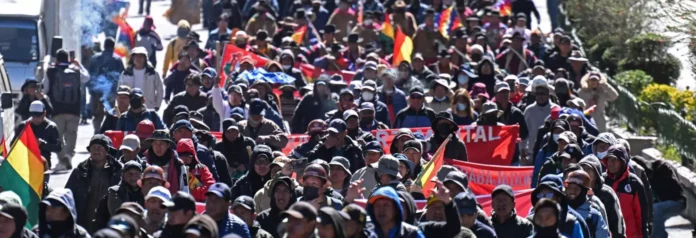
On June 10th more than 50,000 workers and peasants took to the streets of La Paz with the demand for the government to resign: “either you resign or we will throw you out”. In the face of harsh repression from the police and the army massive assemblies of workers and peasants meeting across the country agreed to an indefinite general strike as well as blockades in major traffic areas. The COB, the Bolivian major union federation, had also approved a general strike weeks earlier while the miners of Colquiri and Huanuni and the rank and file of the mining union federation rebuked their general secretary and demanded a mass march on La Paz, the capital city.
It is significant to note that leaders of the COB and other popular and peasant organizations such as FEJUVE have raised the possibility of accepting the negotiation proposals of the government after more than a month of uninterrupted mobilizations. But significantly, the mass movement has consistently demanded a clear strategy to defeat and remove the neoliberal government showing that the struggle has transformed the consciousness of workers and peasants against the government.
The movement erupted in the face of an escalating economic crisis, austerity, privatizations, massive corruption scandals, and the complete subjugation of the neoliberal government of Rodrigo Paz to the big imperialist companies and multinationals. The government responded with ferocious repression when the movement first erupted a few weeks ago when protests demanded an end to cuts in social spending by the government. The result was to see the beginning of an uprising and a revolutionary upsurge to throw out the Paz government.
On May 1, the national council of the workers union federation (COB) voted to call for an indefinite general strike against the government’s austerity plans partly under pressure from the rank-and-file workers. COB had bureaucratically signed an agreement with the Paz government in January which had paralyzed and demobilized the mass protests that were sweeping the country in November and December 2025. The COB conservative leadership intended the call for a general strike to let off steam and was not organized regionally or nationally, by for example the election of strike committees and coordinations with the popular and peasant unions. However, this worked out in a completely different way than the leadership anticipated. The enormous pent-up anger erupted in the form of thousands of workers, young people and peasants taking to the streets and organizing road blockades in strategic areas, electing strike committees and making the mass general strike a reality along the lines of revolutionary uprisings of 2003, 2005, 2019 in Bolivia.
In May, facing a mounting radicalization of the struggle, the leaders of the COB, the FEJUVE and the peasant organizations Tupac Katari and CSUCTB pledged not to negotiate anything separately or without the endorsement of the rank and file. As a leader of Tupac Katari acknowledged, “the people have overtaken us, they are tired of this government and the main demand is the resignation of Rodrigo Paz.” This in effect prevented attempts at mediation as direct action pushed back when the army or fascist gangs attempted to break the blockades.
Hysterical international reaction
It is no surprise that the reactionary rightwing Trump Administration, the Bolivian capitalists and the oligarchies across South America have shown huge support for the neoliberal government of Paz. Pete Hegseth warned that “Bolivia should not fall prey to narco-terrorist domination” and Marco Rubio demanded the increase of “logistical support” to deal with the “illegal blockades”. The eleven Latin American right-wing and far-right governments, which are part of the “Shield of the Americas with Washington”, on March 7 signed a joint declaration denouncing the blockades as “aimed at subverting the constitutional order and destabilizing the democratically elected government of Bolivia.” (Declaración conjunta de los miembros del Escudo de las Américas)
After the serious setbacks the Trump regime suffered with the defeat of ICE in the face of massive mobilizations in Minneapolis and the defeat for US imperialism in the Gulf, the fall of a neoliberal puppet in Bolivia would be a serious setback to the plans of Washington to crush any resistance to its domination of South America. A historic victory of the masses of Bolivian workers and peasants would also provide a huge boost for resistance and class struggle in Latin America in an increasingly volatile situation in Chile, Peru, Colombia, Argentina and beyond. The election of a far-right Trumpist candidate in Colombia and the continuation of the crisis-ridden Millei regime in Argentina demonstrates how extremely volatile the current situation is in Latin America.
The international capitalist media have unleashed a hysterical campaign of hatred against the blockades, which are now labelled as organized by “terrorists financed by drug traffickers and foreign countries. “Reflecting on some concerns about immediate reaction, The Economist warned, that in 2003, during another uprising: “When President Gonzalo Sánchez de Lozada sent soldiers to clear blockades in El Alto in 2003 and dozens of civilians were killed, a general strike broke out that led to his resignation and exile. That surely worries Mr. Paz. (!)”
In the middle of a mass revolt in Bolivia, Brazilian “left” President Lula decided to show his support for Paz by blaming the demonstrators for the crisis in the country and “supporting the negotiations”. In a similar vein, Colombian President Gustavo Petro while denouncing the repression against the demonstrators, called on Paz to be more open to dialogue by offering to mediate to avoid “chaos”. It is clear from the reactions of Lula, Petro and the Economist that resorting to a bloodbath with the massacre of protesters would have unpredictable consequences both in Bolivia but also across Latin America.
In Bolivia, it is increasingly clear that large sections of the working class, young people and peasants have concluded that Bolivian capitalism is unable to solve even the most elementary problems and any government promises are laced by fraud. This has been amplified by the frustration and failed experiences of the reformist MAS government of Evo Morales. Initially Morales and MAS enjoyed significant mass support with the nationalization of hydrocarbons and increasing exports to Argentina and Brazil which allowed for increased social spending and measures to increase living standards of the mass of the population. After 2019, the MAS government (having failed to end the power of the landowning and capitalist oligarchs) presided over a huge economic crisis and partial collapse of Bolivian capitalism, and corruption scandals. The result was the disqualification and expulsion of Morales and the absolute discrediting of the government and MAS. This opened the door to demoralization and an overwhelming electoral defeat and eventually to the victory of Rodrigo Paz in 2025.
When Paz took office, poverty affected 40% of the population of Bolivia, and with inflation at 20% inflation wages increased by barely 5% . In a country that is rich in gas and lithium (a mineral critical for batteries internationally) the Bolivian oligarchy condemns millions of people to poverty and shortages.
A question of power
It appears that large sections of the workers and peasants who are leading the current revolutionary upsurge understand that that the time to achieve a victory is now, and that the solution to their problems is to defeat the oligarchy and open the way for a government of the workers and peasants that break with the logic of capitalism.
There is an urgent need for the current insurgency to unite with the broad movement of workers and peasants and oppressed minorities around a program to defeat the government of the oligarchs and capitalists and demand a program to end poverty.
The experience of the last two decades in Bolivia and across Latin America and beyond show clearly that the way to eliminate unemployment, poverty and improve health, education and housing is to bring the mining and hydrocarbon resources, the agro-industrial corporations, banks and imperialist cartels dominating the country under the democratic control and management of workers and peasants. In the same way and end can be brought to racism against indigenous people and the epidemic of violence against women.
The Bolivian working class, peasants, women and indigenous people are once again in the forefront of the anti-colonial and anti-capitalist struggles in Latin America showing the potential for resistance and socialist revolution as the alternative to oppression, poverty and racism.