

Caterina Maggi
The following article was initially published by ControCorrente, an Italian Marxist organisation in close collaboration with Internationalist Standpoint, in its weekly newsletter of the 5th of June.
One of the first things I text my contact after arriving in Nicosia—following an hour-long bus ride from Larnaca Airport—is: “Can you confirm something for me? There are elections tomorrow, right?”. On Saturday, May 23, the eve of an election that is unusual even by Cypriot standards, I make my way to my hostel through driving rain, looking around for any sign of the day to come. Nothing. Not a billboard, a banner, a poster, or even a humble leaflet bearing a candidate’s face and a party slogan.
I check my notes once again, where I have marked down every major international election scheduled for 2026. Then I check online. Everywhere, the same confirmation: on May 24, Cyprus and its six districts—Nicosia, Limassol, Famagusta, Larnaca, Paphos and Kyrenia—will go to the polls to elect 56 new members of parliament. (The 24 seats allocated to Turkish Cypriots have remained vacant since the island’s division.) And yet, despite an extraordinary number of candidates—753 individuals representing 15 parties and independent groups—it all feels strangely empty, unreal, suspended in time. I do not sense the subtle excitement that accompanies Italy’s pre-election silence, for example. “Silence” is perhaps the wrong word, given how easily social media allows campaign rules to be circumvented nowadays. So how is this possible?
The following day, on my way to the polling stations, I ask Marinella Payiatsou—my local contact on the island, a worker for an association supporting people with cognitive disabilities and an internationalist activist—for an explanation. She offers two possible answers. The first: electoral silence is taken seriously here. The day before the vote, posters are torn down, campaign materials disappear, and anything that might influence voters is removed from public view. The second: Cypriots simply no longer care very much about elections.
Electoral Inertia
This time around, voters competing for the parliament’s 80 seats found themselves facing a contradiction. On one side stand the two towering traditional parties: the liberal centre-right Democratic Rally (DISY) and the self-claimed Marxist-Leninist Progressive Party of Working People (AKEL), alongside a third centrist force, the Democratic Party (DIKO), which, as Marinella explains, “is something of a weather vane—it acts more as a kingmaker than anything else.”
On the other side is the rapid proliferation of smaller parties, fringe movements and political newcomers. Among them is ELAM, which could quite be described as the Cypriot branch of Golden Dawn, the neo-Nazi party outlawed in Greece.
Then there is a more fluid novelty: Fidias Panayiotou, influencer and Member of the European Parliament, who has leveraged his YouTube following to build political support. His brand of populism, born from social media buzz, resembles a political programme that is everything and nothing at once. On the one hand, it appeals to direct democracy and the idea that everyone should have a say; on the other, it employs hardline slogans borrowed from far-right and anti-immigration movements, such as “Everyone Out of Cyprus!”
“He appeals to everyone because one day he wakes up and expresses ideas that I can even agree with,” Marinella says. “Then the next day he completely changes direction.” He is, in many ways, a catch-all figure reflecting the rise of anti-establishment parties and movements across Europe.
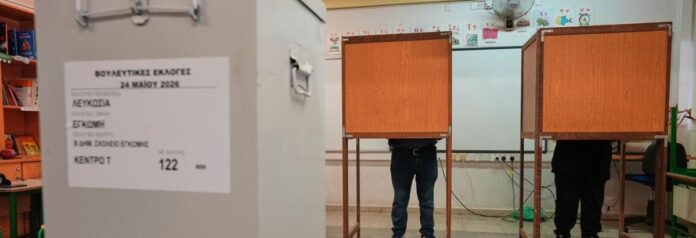
I accompany Marinella to her polling station and observe the crowd while she votes. The school car park is full, and there is a steady flow of people coming and going. Whether this turnout means anything—and whether it will last throughout the day—remains to be seen.
I glance at the noticeboard displaying the electoral lists. I would not be surprised if voters became so overwhelmed that they accidentally marked the wrong party. The list of candidates and political formations looks endless. My eyes are inevitably drawn to ELAM’s emblem: a symbol resembling a Roman gladius. Their slogan for this election reads: “Religion, Nation, Tradition.” The parallels with similar movements elsewhere are hardly subtle.
After watching the queues at the polling station—promising enough for 11 a.m. on a sunny Sunday—we sit down at a small café in a bohemian corner of central Nicosia, waiting for Marinella’s partner, her son and his wife.
While we wait, I strike up a conversation with Dimitra, the young bartender, who appears only a few years older than me. I ask whether she has voted, and if not, whether she plans to. The answer to both questions is no.
“I spent a long time abroad,” she explains, “and when I came back, I forgot to re-register on the electoral rolls. But honestly, I only forgot because I was already sceptical about whether it was worth doing in the first place. Forgetting was just a consequence.” Why was she sceptical? “Because it feels like nothing ever changes. Everything seems hopeless. I don’t see how things can improve, and I don’t even know what I should expect. It feels as though we’re moving towards something like Britain, where the major parties are both in crisis. Don’t get me wrong,” she adds, “having several parties is better than having only two. But that doesn’t automatically make things better. It also feels like the distinction between left and right has disappeared.” The problem of youth voting here, as in many other European countries, is that major left-wing parties have ceased to function as a genuine counterweight. They have had opportunities to govern and, once in power, have often failed to meet expectations. They have become the very system they once criticised. Increasingly, there appears to be only one political direction available—whether from the left or the right: to tear down a system perceived as suffocating, stagnant and incapable of providing solutions.
It is a message that resonates with younger generations as well, worn down by years of political paralysis and anxious about the world around them. “I think many young people my age will vote,” Dimitra says. “But I also fear that just as many will stay home, and that those who do vote will vote for the far right.”
Later, Andros Payiatsou, Marinella’s brother and a representative of the Greek socialist organisation Xekinima—part of the Internationalist Standpoint network—offers a similar assessment.
“The message of groups like ELAM works because it uses strong, macho language that has a powerful appeal among young men.” One of ELAM’s central themes is migration. “On an island of one, perhaps one and a half million people, there are around 25,000 migrants,” Andros says. “About 5,000 have refugee status and another 18,000 enjoy subsidiary protection—and they complain that this is too many.” “In reality there are two categories of migrants here. Those who arrive with temporary work contracts can stay for one or two years before being sent home. Then there are those who arrive by sea or attempt to cross the Green Line. They are pushed back violently.”
He continues: “And many of them work in sectors with almost no protections, such as fast-food delivery services. People also have no historical memory. They forget that once, we were the refugees.” He is referring to the war that, beginning in 1974, split Cyprus in two, scattered checkpoints along a dormant yet unresolved frontier, and divided the island between a northern part—recognised only by Turkey—and a southern Republic of Cyprus that is now a member of the European Union.
The Unspoken Guests: The Green Line, the EU, and Warlike Neighbours
Among the issues driving people to the polls is security.
“If you promise people security after dividing them, it doesn’t matter whether the promise comes from the left or the right: people will vote for you, especially older voters,” Dimitra concludes before leaving us at our table. Not everyone, however, sees security as a priority. Among the voters I manage to stop outside polling stations, two offer sharply contrasting views. The first, a somewhat timid man in his thirties, tells me: “I voted for the right because we need to think about our economy and our sovereignty. That’s what matters.” Another voter, aged 43 and unwilling to reveal whom he supported, sees things very differently. “Whether the economy succeeds or fails is also our responsibility—we have to manage it ourselves. If there is something the government should focus on, it is justice, corruption and social inequality.”
Yet security is no minor issue in Cyprus. Only this spring, a drone of uncertain origin—British intelligence ruled out an Iranian connection—struck the UK military base at Akrotiri. The base is sovereign British territory, one of two British enclaves on the island, the other being Dhekelia, both retained by the United Kingdom since Cyprus gained independence in 1960. Since the British government opened its bases to NATO allies, Cyprus—though not itself a NATO member—has increasingly found itself looking anxiously eastward, just as it once looked north.
“So,” I ask over lunch, “you still have Turkey to the north. Doesn’t anyone campaign on ideas such as ‘reunifying the island’ or something similar?” “Oh yes,” Marinella replies. “Nationalists bring it up all the time. The problem is that nobody actually offers a solution.” “And AKEL did the same thing,” Andros adds. “When they came to power fifteen years ago, they claimed they had a solution. In practice, they did nothing.” Why? “It’s not so easy,” Andros tells me later over coffee. “On the one hand, Turkey—which has applied for membership of the European Union—is strategically important to the EU. On the other hand, they simply don’t have the resources to confront Turkey effectively.” Turkey is a crucial European partner, particularly when it comes to energy policy. The natural gas fields of the Eastern Mediterranean involve Cyprus, Turkey and Israel alike. It is also central to migration policy, serving as one of the countries to which the European Union has informally outsourced the management of refugee flows from Syria, Afghanistan, Palestine and the various conflicts to Europe’s east that remain unresolved.
And, unlike Cyprus, Turkey is a member of NATO, as are many European countries. Any serious escalation would therefore create considerable diplomatic discomfort. “When we joined the European Union,” Andros says, “many people hoped that Europe would eventually solve the national question.”
By the end of the day, the polling stations close. The results are awaited without much enthusiasm. Turnout ultimately reaches 66.4 percent. As I head back to my accommodation, Andros leaves me with one final reflection: “The problem behind all this disillusionment is that people expected Europe to change something. It didn’t.”
The Other Side
The first sign that there is “another Nicosia” comes from the call to prayer echoing across the wall, where the minaret of Selimiye Mosque rises above the skyline. As the sun begins to set, I head towards Ledra Street. The journey feels almost like a descent into an underworld. I pass through narrow streets lined with boarded-up windows, abandoned houses and coils of barbed wire draped across crumbling facades.
Then I emerge onto the Ledra Street crossing. On one side lies the familiar tourist promenade: Starbucks, souvenir shops, casual restaurants. Music drifts through the air. People stroll along eating ice cream and enjoying the cool evening breeze after yesterday’s downpour. With an Italian passport, I pass quickly through the checkpoint separating the Republic of Cyprus from Northern Cyprus. The atmosphere changes immediately. It is like stepping through a mirror. The streets are largely empty. A few scattered pedestrians make their way towards the border crossing from the opposite direction. The cafés are quiet. Lights are sparse. Music plays inside the handful of bars that remain open, but few people seem interested in filling them. I remember something Marinella had said during Sunday lunch. “Here, people estimate that tourism could fall by as much as 40 percent because of the Middle East crisis and the reduction in flights. But I suspect things won’t be any better on the other side.”
I decide to return the following day to see for myself. In daylight, North Nicosia appears less bleak, though still far from crowded. I stop at a café and strike up a conversation—in a mutually improvised version of English—with the owner, Yousel. We begin with the usual topics: the weather, football, tourism. “There aren’t many people around,” he admits. From there, the conversation drifts towards politics. What does he think about the elections that have just taken place across the divide? Yousel shrugs. “Nothing changed before. Why should it change now? Besides,” he adds, “I’m Turkish.”
In theory, perhaps. In practice, although Northern Cyprus is entirely dependent on Turkey, it does not exist in international law. That makes life particularly difficult for those who live there. “If I want a travel permit, I have to apply for it through Turkey,” Yousel tells me. “And by the time everything is paid for, it costs around €5,000. Without that visa, Europe would send me straight back as soon as I landed. And anyone who flies into our airport can’t simply cross to the other side afterwards—it is considered an illegal entry.” I thank him and head back towards the checkpoint, his words still echoing in my mind: I’m Turkish. Not everyone in the north sees themselves that way, but the divide remains undeniable—a wound that has never truly healed, merely settled into a dormant state.
As I had been told around the lunch table only the day before, many Turkish Cypriots feel betrayed by the south, where, after an initial period of coexistence, the very right-wing forces that today champion Greek nationalism undermined the possibility of living together. “The national question cannot be solved from above within a capitalist system,” Andros argues. “It has to be solved from below.” When the results finally arrive after 6 p.m., they reveal a familiar pattern of change without transformation. DISY weakens but remains the largest party with 27.1 percent of the vote, closely followed by AKEL on 23.9 percent. Less quietly than many had hoped, ELAM secures 10.9 percent and doubles its parliamentary representation to eight seats. If President Nikos Christodoulides wants to govern effectively, he will need to do so more carefully, building new alliances in an increasingly fragmented political landscape. Fidias Panayiotou’s party, Direct Democracy, wins 5.4 percent and four seats. It may look like a political revolution, but it is not quite one. Christodoulides, elected as an independent, is himself a former DISY member.
At the end of our brief conversation, Dimitra had remarked: “I don’t trust political parties. I have more faith in grassroots movements.” Perhaps that is what might one day help stitch together a wound that has remained open for decades.
For now, however, the buffer zone and the election results tell the same story. Cyprus remains suspended in a kind of limbo. It has tamed its ghostly half.Tamed, perhaps— never truly domesticated.