

Interview with Ecehan Balta, an activist of Peoples’ Climate Summit
How would you describe the stage the ecological crisis has reached globally?
Today, it is no longer enough to speak of the ecological crisis simply by saying “climate change is deepening.” We are at a much more advanced stage. On the one hand, carbon emissions are not falling, and the latest data show that fossil fuel-based CO₂ emissions have once again reached record levels. On the other hand, the natural sink areas that absorb this carbon are also being eroded. Forests, wetlands, grasslands, coastal ecosystems, soil, and marine systems are being weakened both by the impacts of the climate crisis and by the direct assault of capital. In other words, the system is not only producing more carbon, it is also destroying the natural mechanisms that absorb it.
That is why the crisis is no longer simply a matter of “reducing emissions.” We are facing a far broader crisis of life. Water cycles are being disrupted, the regenerative capacity of soil is declining, agricultural production is becoming more fragile, seas are warming, and biodiversity loss is accelerating. This is especially visible in regions such as the Mediterranean basin. So what is being eroded are the material conditions for the reproduction of life on the planet. The issue is not only rising temperatures; it is the disruption of the ecological rhythms that make life possible.
How are governments trying to solve this crisis?
Capitalist governments are not really trying to solve this crisis. More precisely, rather than changing the regime of production and accumulation that lies at the root of the crisis, they are trying to make the crisis manageable and profitable within the system’s own logic.
The clearest expression of this is the financialisation of climate. Carbon markets, emissions trading systems, offset mechanisms, green bonds, and areas commodified under the label of “nature-based solutions” are all different instruments of the same approach. The basic logic here is this: instead of questioning fossil capital, the regime of endless expansion, industrial agriculture, logistical chains, and the mining-extractivist model, governments build a new market architecture around them.
That is why we criticize all approaches that present the market as a solution to the ecological breakdown. Because carbon markets do not truly transform the model of production; they simply reorganise the right to pollute. Major polluters try to appear “climate-friendly” without undergoing any substantial transformation, through offset projects elsewhere, accounting tricks, or trading mechanisms. In other words, the infrastructures that generate the crisis remain intact, but a green wrapping is placed over them.
What is your alternative solution?
Our solution begins with seeing the crisis not as a technical governance problem, but as a political-economic regime problem. For that reason, our answer is not more market, but the radicalisation of the movement, the clarification of demands, and the centering of justice. By radicalisation, we do not simply mean harsher rhetoric. We mean clearly identifying the causes of the crisis, genuinely advocating a phaseout from fossil fuels, and placing energy democracy and food sovereignty, public ownership and planning, and the decision-making power of local communities at the centre. In other words, instead of waiting for the market to save the climate, we argue for social forces to build a new path of transformation towards a socialist organisation of production.
The Kandy process and the Belém experience were important precisely for this reason. 3rd Nyelene Food Sovereignty Forum at Kandy represented the moment when scattered struggles converged on a common political threshold, produced a common language, and sharpened their demands. Belém was the extension of this into a broader, more public, and more mass political arena. Put differently, Kandy helped strengthen the common programmatic line, while the Peoples Climate Summit in Belém expanded its international visibility, its street power, and its global ties. For us, both of these processes were deeply instructive, because they showed that the global movement offers one another not only solidarity, but also strategy, organisational experience, and political courage.
In Kandy, struggles listened to one another more deeply, sharpened their common demands, and centred the idea of systemic transformation. In Belém, this accumulated political energy became more visible in the streets, in forums, in declarations, and in international encounters. So the solution we are talking about is not simply a few policy proposals. The real issue is whether popular movements can learn from one another and build a political line that is clearer, more organised, more internationalist, and more radical. Kandy and Belém showed us that this is possible.
Where does Turkey stand in this process?
Turkey is not outside this global picture. It stands right at its centre, and in a very specific and contradictory way. On the one hand, it wants to position itself at the centre of climate diplomacy by hosting COP31. The fact that COP31 will be held in Antalya on 9-20 November 2026 makes this concrete. But on the other hand, if we look at the country’s energy structure, we see that dependence on fossil fuels continues. According to the International Energy Agency’s profile of Turkey, the country remains heavily dependent on oil and gas imports, and fossil sources still carry significant weight in electricity generation.
The specific problem in Turkey is this: the discourse of “green transition” not translated into a real ecological transformation. On the contrary, it becomes an instrument for opening up new fields of accumulation. Critical minerals, new mining sites, energy infrastructures, transmission lines, industrial clusters, and the opening of coastal and agricultural areas to new investment pressures all come to the fore in this framework. In other words, Turkey (as all other capitalist countries) is adopting a policy of “green” extractivism rather than a path of social transformation. Put differently, the logic of nature exploitation that created the crisis is preserved, only now it is repackaged under labels such as “energy transition,” “critical minerals,” or “competitiveness.”
Ecological destruction in Turkey cannot be explained only through the “distant” effects of global warming. What is operating here is a very direct regime of reallocation and plunder. The expansion of mining sites, the opening of coasts to “industrial” tourism and energy investments, the fragmentation of forests, pastures, and agricultural land for corporate projects, and the commodification of water resources are not separate developments. They are the spatial expressions of capital’s search for new profit zones under conditions of crisis. So in Turkey, the ecological crisis is also experienced as a class-based, spatial, and political form of assault.
And when we speak of a “broad-based assault,” we do not mean only an assault on nature. We mean, at the same time, an assault on living spaces, livelihoods, the decision-making power of local communities, and the commons. A mining project does not merely excavate the soil; it pollutes water, weakens agriculture, forces migration, disrupts local economies, and threatens cultural and historical assets. That is why this assault must be understood not only through its environmental effects, but as a much more comprehensive regime of social destruction.
COP31 will be held in Antalya, a coastal city of the Mediterranean. Why is the Mediterranean especially important?
The Mediterranean holds a special place in this discussion because it is one of the most fragile regions in the climate crisis. Scientific literature clearly defines the Mediterranean as a climate change hotspot. The region is warming faster than the global average; sea temperatures are rising, drought is deepening, water stress is increasing, coastal ecosystems are coming under pressure, wildfire risk is growing, and agriculture is becoming more vulnerable. In other words, what is happening in the Mediterranean is not the news of the future, but of the present.
For Turkey, this is even more important. Because ecological breakdown in the Mediterranean is not only an issue for environmental policy; it affects the food regime, public health, coastal life, tourism, migration, labour rights, and regional inequalities. The fact that COP31 will be held in Antalya is therefore not a symbolic detail. The summit will take place precisely in a geography on the front line of the climate crisis, but also in a country where the pressures of construction, energy, tourism, and mining are deeply intertwined. So to speak about the Mediterranean is to speak about the material reality of the climate crisis and how that reality is lived in Turkey.
How are the People’s Climate Summit preparations going?
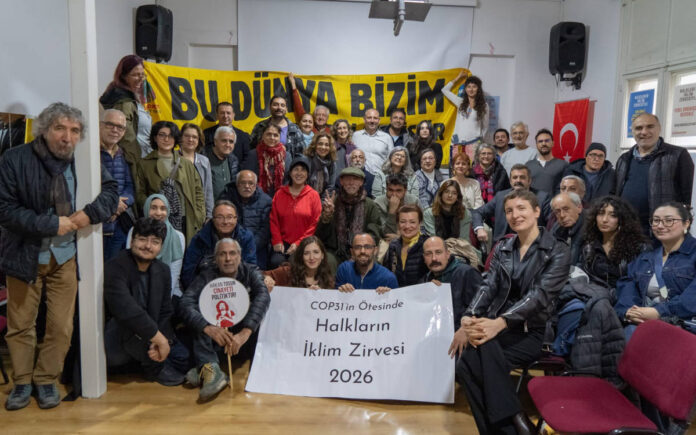
I think the People’s Climate Summit is moving forward on a very strong trajectory. We are talking about a process launched by the call of three major networks, bringing together more than 300 volunteers, deepening through thematic cocoons and working groups, and building ties with more than 90 organisations from around the world. This is extremely valuable. Because we do not see the People’s Climate Summit merely as a parallel event to COP31. It is a counter-space that brings local struggles together, builds international connections, produces political clarity, and constructs the people’s own climate justice perspective against the official COP discourse.
One of the most important things here is this: the People’s Climate Summit is not a defensive line. It is not merely a space that “objects.” It is a process trying to build its own political voice, its own demands, its own terrain of internationalisation, and its own organisational forms. The thematic cocoons and working groups matter for exactly this reason. They allow different sites of struggle to come into contact with one another, produce common demands, and establish a coordination that genuinely works rather than remaining at the level of a superficial coming-together.
What do you expect from the Peoples’ Climate Summit?
First of all, we expect the Peoples’ Climate Summit to internationalise local struggles. It is crucial that a mining resistance in Turkey, a defence of the coastline, a struggle for water rights, a peasant movement, or a local campaign against fossil fuels can meet struggles in Latin America, Asia, Africa, and Europe within a common political language. Because the crisis is global, but its effects are lived locally. Without building a bridge between these two levels, we can neither establish a real network of solidarity nor develop an effective counter-strategy.
In Belém, we gained an extraordinary amount of experience in a very short time. There we saw clearly that the global movement has a great deal to teach one another. An experience won in one place can strengthen a struggle elsewhere. A campaign language developed in one place can provide strategic clarity in another geography. An organisational form built in one context can become a source of morale and direction in another. What we expect from the People’s Climate Summit is precisely to create such a terrain of encounter, learning, commoning, and political multiplication. That is why we see it not merely as a process confined to one summit week, but as a long-term experience of internationalisation.
Our main expectation is that COP31 should not remain merely a narrow diplomatic arena in which states, corporations, and official delegations speak. We want a stronger political space in which peoples, local struggles, labour and ecology movements, feminist and peasant movements, youth, and defenders of life can establish their own voice. Because those who created the climate crisis and those social forces capable of truly stopping it are not the same. There is a very clear distinction between the source of the problem and the subject of the solution.
That is why, for us, the issue is not to observe or participate in COP31, but to establish new processes from below. To build a people’s agenda that goes beyond the language of official negotiations and places life, justice, and a collective future at the centre. We see the Peoples’ Climate Summit as an instrument for this. We want to internationalise local struggles, open up the experiences of the global movement to one another, make the climate justice line in Turkey more visible and more organised, clarify demands, and strengthen the movement along a more radical path. That is the perspective from which we approach events around COP31.
For more info you can contact with [email protected]