

The role of the Workers’ Assembly and class struggle organizing
Co-published on the Workers Resist (DSA Caucus) and Solidarity Now! Substacks. Solidarity Now is a working class organisation which campaigns using a united front approach, connect both unaligned activists and members of existing organisations.
On January 23rd, nearly one million Minnesotans participated in the “Day of No Work, No School, No Shopping.” This was the culmination of months of mass resistance to Trump’s full-scale paramilitary occupation of the Twin Cities, in which tens of thousands were organized into rapid response and mutual aid networks, daily protests, and direct actions. The result was a retreat by Trump and his goons. While DHS operations continue at a lower scale in surrounding neighborhoods and throughout the country, this withdrawal was an indisputable defeat for Trump’s authoritarian agenda.
Even before the “drawdown” announced by former Obama appointee, Tom Homan, January 23rd’s mass strike action was instinctively understood as a turning point in the struggle against Trump’s vicious, white nationalist agenda and its backers, the billionaire class. For decades now, since the Great Recession, movements in the US have struggled to find their way out of an endless cycle of protest and retreat. January 23rd smashed through that barrier and has begun a massive, desperately needed process of reorienting labor, the left, and the wider working class.
Following this leap forward in the struggle, activists at the base of the movement have been seeking ways to emulate and repeat this success. In the weeks following January 23rd, the words “general strike” rolled off the tongues of millions. At work, in cafes, at the dinner table. It was this fact, as much as the degree of organization and grass-roots participation in the Twin Cities, which terrified the billionaires and put pressure on Trump to back down. In those vital moments of wonder and excitement, movement leaders had an opening to escalate and expand beyond one city, beyond the relatively limited number of workers involved. Instead, many of those leaders have sought ways to hold things back.
The closer to the Democratic Party these leaders are, the more pressure they feel to contain the movement. The reason for this becomes clear when we peel back the rhetoric of both corporate parties to reveal that the wizard behind the machine is the Oligarchy: a tiny coterie of billionaires whose money funds both parties, along with many other institutions, including, of course, the corporate media. Non-profit and labor leaders who have come to rely on their personal and political relationships with the Democrats—and in the case of NGO’s, their reliance on foundation funding—know no other way to advance the interests of the working class. No matter how well-intentioned they are.
Liberal status quo, or class struggle change
With the above in mind, the movement has to seriously grapple with the question of who it chooses to follow. Indivisible, Move On, the ACLU, the Human Rights Campaign, and most of the other organizations preparing for another national day of action on March 28th are aiming to capture the energy of the anti-ICE movement, in hopes that Democrats will once again win control of Congress. But each demonstration, even before the breakthrough of January 23rd, has left participants with the question of what comes next, and even what exactly we are fighting for. Indivisible and related organizations have seen hundreds of thousands flock to their chapters and trainings, eager to find the tools necessary to defeat Trump.
The character of the chapters of these organizations varies from neighborhood to neighborhood and city to city. Where the movement has swelled from below, the chapters tend to take on a more active role in the movement. Indivisible chapters in particular, alongside local immigrant rights organizations, have done important work to educate with know-your-rights trainings, or gone further in helping coordinate actions against ICE.
As a national coalition, however, the organizations that decide the date and slogans of each No Kings protest are doing so entirely from the top down, with zero democratic structures or transparency as far as these or any other decisions are concerned. Without such structures, there is no vehicle to build on the momentum which produced and emerged from January 23rd. Most people don’t even know the names of the leaders of the No Kings coalition. That leadership has not moved beyond slogan of No Kings or the strategy of electing Democrats. If this decision-making vacuum continues through the November midterms, it will hand the leadership of the movement right back to the billionaire-funded Democratic Party.
This is not a criticism of the many thousands of activists trying to shape these organization into a fighting force. Some Indivisible and 50501 chapters, for example, are participating in May Day Strong and Workers’ Assembly organizing. Rather, the criticism is of the non-strategy of its leadership, and the fundamental weakness created by their relationship to a party of the billionaire class.
No Kings AND No Billionaires
It is not enough for our slogan to be No Kings. It must also be No Billionaires. The real source of Trump’s power is the super-rich—a few thousand individuals—whose wealth has now eclipsed the collective wealth of the bottom 90% of Americans. Nor is it enough to simply elect Democrats in hopes they will slow down Trump’s attacks on our democratic rights, any more than they slowed down funding for the genocide in Gaza under the Biden administration. The real power centers of the party are controlled by those on the side of the billionaires. There is currently a fight taking place within the Democratic Party with left-wing insurgents challenging and sometimes winning primary races against the old guard. Yet even then, they have played little role in building on the success of January 23rd.
This is not so much a personal failing of democratic socialist and progressive elected officials, but the consequence of being caught up in the internal machinations of a billionaire-controlled party. As it stands, the billionaires are infinitely better organized than the Democrats’ working class and progressive voting base. They have control over the media, education, government institutions, a militarized police state, the economy and too often over our movement organizations.
The working class can no longer afford to wait for our leaders to lead; the push will have to come from below. As March 28th approaches, class struggle labor activists, the left, and radicalized workers and youth should begin thinking about how we can regain the momentum of January 23rd and provide democratic spaces to organize the movement. Returning to the cycle of protest and retreat is a death sentence both figuratively and literally. For the movement, and thus also for the millions of people at the receiving end of authoritarianism and the US police state, crumbling healthcare and education, endless cycles of war, and environmental destruction.
January 23rd & May Day Strong
Following Trump’s second election, and continual betrayal by Democrats, it has become clear to many thousands that the path which took the Twin Cities to January 23rd is the only alternative to the path which took the nation to January 6th.
January 23rd provided, for the first time in generations, a concrete example of organized, working-class power that goes beyond the cycle of protest and retreat that has plagued our movements. The anti-authoritarian movement spurred on by the Trump regime has been reanalyzing what methods are required to defeat authoritarianism. Activists in labor and social movement circles around the country have been discussing what it looks like to pull off a coordinated national day of strike action.
In many cities, May Day Strong (MDS) coalitions have begun to form. The MDS coalition was initially launched locally in Chicago by the Chicago Teachers’ Union (CTU), as an attempt to bring unions together at their tops in preparation for coordinated strike action that has been proposed by the UAW leadership for May 1st, 2028. Minnesota saw a similar effort in 2023-2024. While not quite successful at its main goal of “contract compression” (the act of lining up contract end dates, which would legally pave the way for a cross-union strike), the Twin Cities effort had the effect of pushing union leadership closer together. It was out of this process that the January 23rd labor-community coalition developed.
These are the first steps in breaking from the suffocating grasp of corporate politics. Turning toward the power of organized workers and away from dead-end strategies that force us to rely on the two-party system. We should celebrate each step taken in this direction by labor and social movement leaders. The base of the movement cannot rest until this process is complete. As it stands, our leaders, even those leaning into class struggle, are caught between us and those who control the levers of power in government.
Understanding pressures on labor leadership
At the top, pressure comes down heavily from corporations and their political agents. The mass strike of January 23rd scared the billionaires, who then put pressure on the Democrats to contain the movement. In turn, Minnesota Democrats like Gov. Walz, Mayor Frey, and Senator Klobuchar used their relationship with labor leaders to hold back the unions. We could imagine the conversation went something like this: “We need you to give us space to negotiate with the Trump administration. If the movement grows out of hand, Trump is likely to retaliate. We have to allow him a way out. Business is hurting and we need stability. We can negotiate a compromise that reduces the chaos.” In turn, labor leadership, concerned with the fraying relationship between themselves and the Democrats, would then be tasked with making the case to local labor leaders.
We cannot know what words are exchanged behind closed doors, but we can observe the results. Within weeks of January 23rd, Minnesota Governor Tim Walz had signed off on cooperation between local and state law enforcement and DHS. Tom Homan then announced a drawdown, the result of which has been the continuation of operations in the surrounding suburbs. Instead of a concentrated attack on the whole working class of one relatively dense metropolitan area, which had successfully organized resistance, the maneuvering of Democrats has allowed Trump’s deportation machine to quietly pivot. This fact alone should make clear how vital it is that we break our leadership and our organizations away from the influence of the two corporate parties.
DHS is in the process of converting dozens of warehouses into concentration camps and spreading operations out around the country. Now, Trump is testing Steve Bannon’s strategy of sending ICE into airports in order to normalize the experience of DHS checking for papers ahead of the Midterms. Spreading out operations in this way has made it infinitely more difficult to organize a response, especially as most of the country is far less organized than the Twin Cities at this stage.
The Workers’ Assembly & WSC
At the bottom, pressure comes when workers are organized and mobilized behind bold demands, usually facilitated by the anti-capitalist left. In Minneapolis, this role was taken up by the Workers’ Solidarity Circle (WSC), which “emerged from the collaboration between three different political organizations around the SEIU-led 2024 contract compression—the so-called “Minnesota Miracle.” Twin Cities Democratic Socialists of America, Black Cat Workers Collective, and the Red Pine Revolutionary Collective had been invited to build a labor-left “Solidarity Table” for what was originally intended to be a powerful alignment of contract negotiations (and potential strikes) among dozens of Minnesota unions in March of 2024. With WSC, we committed to revisit that united-front formation in order to actually concentrate the power of the militant, anti-authoritarian, class-struggle wing of the Twin Cities labor movement.” (Workers Resist article – From Whistles to Work Stoppage)
The difference between the January 23rd coalition, which saw organization leaders stick together, and the contract compression campaign, which gradually fell apart, was the role of the base of the movement. As SEIU leader Greg Nammacher put it in an interview, “the community made the call for this day… Members began telling us in large numbers that they were going to honor that call… 95% of them said they were planning not to go to work.” If union and non-profit leaders did not hear this call, others on the labor left and in left-wing organizations would.
The major weakness of May Day Strong coalitions is that discussions are taking place between staffers and labor leaders, rather than between the rank-and-file of different unions. This dynamic has the effect of making the movement top-down, and too often constraining its aims to the fearful conservatism of leadership who constantly feel the pressure from above, and too rarely from below.
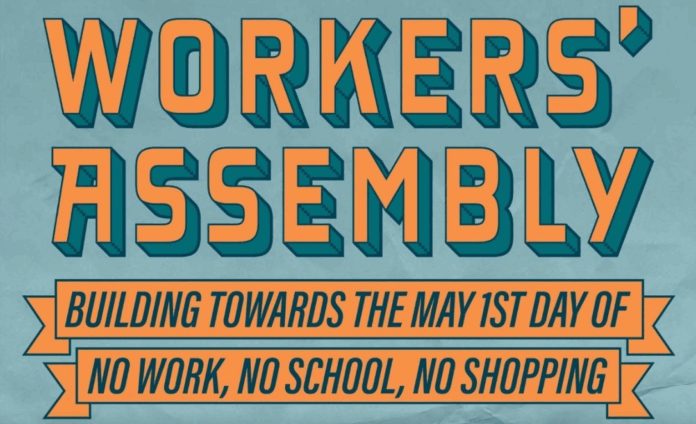
With that in mind, WSC, anti-capitalist organizations, and left-wing unions organized the Workers’ Assembly. “The meeting, titled “Workers’ Assembly to Defeat ICE and Plan the Next Mass Strike,” drew nearly 400 working-class fighters, more than a dozen different unions, and people from both neighboring and coastal states. Besides members of a variety of syndicalist and socialist groups, a large number of workers who belonged to no group were in attendance… One long time union activist described the assembly as “one of the most profoundly democratic meetings” he had ever been to. Another union leader said she wanted to “bottle what had just happened and send it out to cities across the country”. The resolutions passed, mostly by acclamation, were very concrete: build for a May 1 mass strike in Minnesota and create actions that will build support for that.”
Rather than trying to substitute themselves for the official labor leadership, the assembly took these leaders up on their tentative agreement to mobilize for mass strike action on May 1st. May Day Strong coalitions around the country are also in agreement with this plan.
But labor leaders rely, often too heavily, on existing energy within their unions to assess what type of action is possible. The problem with this line of thinking is that most union members are waiting on their leaders to let them know what is possible. Our movement needs spaces where the most active and militant workers can talk among themselves, to get a sense for what others are willing to do. In this process, workers can gain confidence to take bold steps forward. In turn, labor and community leaders will feel this pressure and are more likely to follow through with escalatory actions. This is the dynamic at play in the anti-authoritarian movement at this stage.
May Day is just the beginning
The examples from the Twin Cities have helped provide a framework in the form of the Workers’ Assembly, a practice in mass democracy for the movement; and the organizing force behind it, the Workers’ Solidarity Circle, a coalition of class-struggle labor activists and left organizations. For the movement to survive, similar forms of organization must be taken up.
It is always easier to overcome division and disorganization when we can all agree on a single point of attack. May Day (5/1) 2026 can provide such a focal point for all those serious about escalating and expanding the anti-authoritarian movement. As the world economic and political situation continues to spiral, the movement’s rank-and-file must have organizations through which we can collectively game out responses to crises.
As these crises grow and compound, as working people approach a breaking point under the crushing weight of an unaffordable economy and the looming threat of an all-out war, pushed to the brink by authoritarian destabilization, more and more people will seek out ways to get organized and replicate the methods of January 23rd. Going beyond May Day, there will be countless more crises for us to take up as a united front.
Even now, the question of how to organize an anti-war movement looms over the left and the working class as Trump’s actions are causing death and destruction in Gaza, the West Bank, Lebanon, Iran, and throughout the Persian Gulf, threatening to topple the global economy. With the vast majority of Americans disapproving of another conflagration in the Middle East, there is no reason we cannot reignite the anti-war traditions of the 60s and 70s, save for the current lack of organization and top-down, or no, leadership. Come November, we will be in a dire situation if Trump’s attempt to interfere in the election is met with a similar disparity between mood and action.
As of this moment, the Democratic Party and all those movement organizations connected to it are attempting to make voting the primary outlet for expressing outrage with the Trump regime. Yet they have made no plans to actively resist election interference by ICE or other right-wing forces. We should not forget that the outcome of the 2000 Presidential election was determined by a gang of Republican thugs disrupting the ballot count in Florida, aided by the actions of a Right-wing majority on the Supreme Court. We need a movement that is organized and prepared to defend the elections, and beyond that, to ensure the Democrats cannot continue playing dead.
If May Day coalitions like those organized by WSC can sustain organized spaces, they can become the organizing center of a much larger, more effective movement. They can act as a counterweight to Democrat led initiatives, which seek to keep the peace (between billionaires and workers), even if it means war (in which only the workers die).
¡Unido, jamás será vencido!
Any movement that aims to defeat authoritarianism and the billionaire class behind it must be organized nationwide. While we lack the current structures to coordinate a class struggle movement on this scale, the basis for such a structure is already taking shape. It is vital that we begin to coordinate with one another. Already, workers, labor activists, and socialists across the country are beginning to take up the Workers Assembly. Philadelphia, Chicago, Rochester, NY, and Madison, WI have assemblies on the books. Undoubtedly, similar democratic movement spaces are being formed in dozens more cities as this is being written.
Activists involved in any way with coalitions and organizing efforts similar to those of WSC and the Workers Assembly need to create links. A first step could be to meet virtually for a discussion on how we can relate to one another; how we can coordinate our actions, demands, and strategies; and share lessons about our respective efforts. The US is at the beginning of a massive realignment in the working class, and so too within our unions and organizations. All those awakening will be looking for sustainable, democratic, and non-sectarian organizing spaces. That means rank-and-file-led, class-struggle organizing. We have no time to lose in making the strongest case possible that we can provide that space.