

Read the previous parts here:
Trump’s policies will inevitably cause a major intensification of class struggles in the US. We are not saying anything that is not obvious, a quick look at what is happening in America today confirms this reality.
Class struggle
A few months ago, in October 2025, we had one of the largest mobilizations in American history, with an estimate of 7,000,000 on the streets in 2,700 different protest rallies across the country, with the central slogan “No Kings” (this was the second “No Kings Day”, aimed against Trump’s efforts to acquire excessive powers).
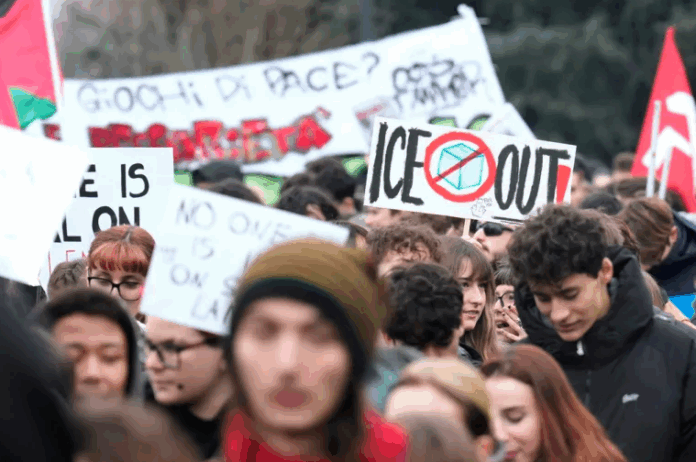
More recently, on January 23, we had the partial general strike, imposed from below, in Minneapolis –called not for trade union but for political demands, against ICE– and the protest rally attended by 100,000 people, in response to the cold-blooded murder of Renee Goode.
America is currently on edge due to the brutality of ICE thugs in their attempt to arrest and deport undocumented immigrants even if they have lived in the US for decades, in the process shooting to kill protesters like Renee Goode and Alex Pretti)
Every city that ICE visits, turns into a “battleground” as residents form communication and mobilization networks as soon as ICE appears, use whistles to mobilize people nearby, hide immigrants, take children to school when their parents are undocumented, etc.
After the strikes in many sectors and the demonstrations in Minneapolis, a discussion has opened among the activists and in the general public about the need for a general strike in the US. This is a development unprecedented in the country’s post-war history.
Apart from the recent events, the entire past decade has been filled with major movements, many of them of historic significance, such as: the major strikes in the auto industry; the recent strikes by Starbucks and healthcare workers; the millions who participated in feminist movements against Trump’s sexist/misogynistic views; the Black Lives Matter movement against the killings of black people by police; and if we want to go back further, to the beginning of the past decade, the Occupy movement that had a global impact.
Reflection on the political level
Class struggle is always, in one way or another, reflected on the political level.
In the US, we recently had the election of Zohran Mamdani as mayor of New York, despite the mudslinging war against him. Mamdani describes himself as a socialist and a supporter of Palestinian rights, which is in complete opposition to the policies of the US establishment.
Mamdani is a member of the DSA (Democratic Socialists of America), an organization associated with the left wing of the Democratic Party, which until a few years ago was insignificant but now has 100,000 members.
Both Mamdani and the DSA belong to the (left) political current of reformism, not that of revolutionary socialism – that is, they seek social change through gradual reforms, not through a confrontation with the establishment and the overthrow of big capital’s power. This is unrealistic – big capital’s power cannot be taken away by gradual reforms but only through social revolution, that places the main/strategic companies/sectors of the economy in the hands of the working people, under their management and control. Therefore, there should be no illusions that Mamdani and the DSA will be able to bring the struggle for the great social upturns necessary in the US to a victorious outcome, even if they have the best intentions. What is important to note at this stage, however, is that these developments reflect a very important shift of large sections of society to the left.
Trumpism has limits, but there is no room for complacency
It is not only working-class people that are reacting to Trump. As has already been extensively developed in the previous parts of this article (Uncharted Waters I, II and III) the most important sections of the ruling class in the US and of the capitalists internationally are not at all happy with his trajectory.
The capitalist think-tanks, the “generals” of capital who look after the interests of American (and international) capitalism as a whole, are extremely nervous: they do not want the fate of their system to be in the hands of individuals who behave uncontrollably and unpredictably. They are very worried about the deep cracks that Trump is causing in their previously main alliance bloc (with Europe) as well as for the escalation of class struggle and radicalization that Trump’s policies are bringing.
Trump has acquired the nickname TACO (Trump Always Chickens Out). It is worth noting that this was given to him, mockingly, by the New York stockbrokers! They gave it to him because, despite all his big words, when he encounters serious resistance, he retreats. Some typical examples are the following: when he threatened China with 145% tariffs, China responded with tariffs to the level of 125% and restrictions on the exports of critical minerals– and Trump quickly backed down (today, American and Chinese tariffs are at 47.5% and 31.9% respectively); when the Greenland issue reached a crisis level, the obedient and submissive Europeans began to discuss (always behind the scenes) for the first time serious counter measures, and again he backed down (on the issue of military occupation – he still demands ownership of Greenland); he started his new trade war last April by “throwing” huge tariffs in every direction, only to end up with tariffs presently estimated at 10-12% on average (which also explains why the international economy did not dive into a recession).
Of course, there is a discussion about whether this is just tactics on the part of Trump, that he is simply asking for more in order to exert pressure and achieve the best bargain with the various sides and countries. This may be true, but it does not negate the above. If he does not find resistance, Trump will do his thing, if he does, he will beat a partial retreat. If the opponent is in a position of weakness, Trump continues unwavering. Perhaps the way he has treated his European “allies” is the most characteristic: he unilaterally raised tariffs for the EU, publicly mocked them, forced them to increase their military spending to 5% of their GDP, while the Europeans tried to appease him, until he threatened to take Greenland by force. Also, the fact that he may ask for more in order to make more aggressive bargaining does not in any way reduce the dangers arising from his policies, either at home or abroad.
The point is that whatever his aspirations, hopes or fantasies, Trump is not and cannot become the uncontrollable dictator, the “emperor” who will rule the planet without checks and with an iron fist, as he would like.
At the same time, however, the Trump administration is something very different from anything in the past. He completely personifies politics (according to his tastes, whims, likes or dislikes) and is erratic, incoherent and unpredictable.
The Trump phenomenon has characteristic elements of Bonapartism – a regime that places itself above society and classes, although it serves the ruling class, in the name, supposedly, of the nation and seeks unlimited and uncontrolled power. A political phenomenon that reflects the crisis in society, which in turn begins with the crisis of the economy. It is a reflection of the crisis of the ruling class, which is unable to maintain its power and control through the usual traditional ways of “parliamentary democracy”.
This is not at all unrelated to the fact that the Left is as weak and marginalized, internationally, as it is today.
When millions of Americans understand that the famous “American Dream” no longer exists and are looking for a “savior”, and when parts of the ruling class hope that a strong figure can restore their lost glories, then you have phenomena like Trump.
Similar conditions in the past led to the two world wars. If this is not the case today, it is because all the major protagonists possess nuclear weapons and can strike their opponents, causing mutual destruction (even if they are struck first). Few (fools) would doubt that if Trump had lived in a historical era in which there were no nuclear weapons, he would have led us with mathematical precision to a world war.
Everything mentioned above, both in this and in the previous articles in this series, show the limits of Trump – who certainly must be treated as a phenomenon and not simply as an individual. But they do not make him harmless or funny. Quite the opposite. Very dangerous conditions and factors are being created, that will not be eliminated even if he leaves the political scene, that reinforce the rise not only of the Far Right but also of Neo-Fascism in the US in the coming years.
We cannot talk about fascism in the US, but…
There is a discussion about “fascism in the US” that we have dealt with quite extensively in previous articles. We reiterate here that the personal perceptions or the current and future course of Trump and the clique that surrounds him are one thing, and fascism as a regime in society is another.
Trump, his ministers, Elon Musk, key MAGA leaders, etc, may have some fascist characteristics or even become conscious fascists in the future, if some of them are not already. And it may indeed be the case that sections of the MAGA movement, especially those involved in ICE gangs, could evolve in the direction of fascist stormtroopers in the future. But that concerns the future, today we do not have a fascist regime.
A key characteristic of a fascist regime is the abolition of any concept of freedom as well as of the organizations, trade union, political and social, of the working class. We are very far from such a reality. And for such a future to exist, the working class and other mass movements of the US must first be defeated, in huge conflicts, much larger than anything we have seen so far.
It is also not correct to talk about “fascistization” of society, as parts of the Left do. We can talk about the existence of fascist characteristics, elements, methods, for example in the policies implemented by Trump and the forces that support him, we can talk of elements of fascistization of the Trump administration, but this is different than when we refer to society.
Because, what is happening today is that, while some sections are moving to the right and some fascist elements find the opportunity to emerge and act (wearing, for example, police uniforms and receiving immunity from the state) some other parts are getting radicalized, are rebelling, searching for left ideas, looking for ways to fight against the system. Along with the right turn and radicalization, there is also a left turn and radicalization. It is important to clarify these so that the Left knows where it stands and how to map its road ahead.
Conclusions and tasks for the Left
For the mass movements and the Left, the messages are clear and so should be the tasks.
Trump, more than any other individual on the planet, shows where capitalism is leading humanity: wars, imperialist interventions, kidnappings of heads of other states (see Venezuela), assassinations of political opponents (by Israel with US support), brutal repression, murders of ordinary citizens by rabid thugs dressed in police uniforms, and so on.
Trump may be defeated in the next elections and his movement may receive a serious blow but it will not die out. Because American society is going through an epoch of crisis Trumpism as a phenomenon and as a trend will continue to exist – in fact, it’s possible that it may be led by people even more dangerous than Trump (as is possibly the case with current Vice President J.D. Vance).
This “current” will look for the opportunity to strike back if it faces a setback in the next elections (midterm and national). This opportunity will be provided to Trumpism on the one hand by the general crisis of the capitalist system and on the other by Democratic Party governments in the US, which only manage with their criminal anti-people policies to strengthen the various shades of Trumpism.
The answer lies on the left – only the Left can provide a way forward. But this general truth is not sufficient in itself. The key issue is what kind of Left is required, what kind of Left can provide an alternative to the barbarity to which the system is plunging humanity.
There is no doubt that the Left in the US will strengthen its forces in the coming period. The reaction to Trumpism will push people to search for left-wing ideas and for organization. The example of the DSA and of the election of Mamdami are typical. In total, the DSA has elected several hundred of its members to various positions, from Congress to local government. We have every reason to rejoice in the successes of the Left internationally but at the same time, we should not lose sight of the limits of this “new Left”, which has appeared in one country after another in recent decades and has, unfortunately, failed everywhere. Probably the most characteristic example is that of SYRIZA in Greece – it not only failed to reverse the policies of the IMF and EU that slashed the Greek GDP by 27% and living standards accordingly in the period 2010-15, but it continued the application of the same policies. Inevitably, it finally collapsed, leaving the Right and the Far Right in Greece to thrive. There have been many similar examples both in Europe and in Central and Latin America. There is no example of a reformist formation in history that has been able to solve the impasse and crisis of the capitalist system through the application of gradual, parliamentary reforms.
Marxists are small but not an insignificant force in the US. They exist in independent formations, within the social movements, within the DSA. They play a role in movements such as the one against ICE (which is a grassroots movement without an organized force behind it) as well as in strike mobilizations and solidarity networks. A very conscious approach is required, that no matter how important the new rise of the American Left and the movements is during this period, there should be no illusions in reformism.
Through all these processes, revolutionary Marxists need to strive to strengthen their forces, with the aim of building mass revolutionary organizations. There lies the answer to the crisis of capitalism which in turn gives birth to the Far Right, the neo-fascist currents, authoritarianism, the new would-be kings and wannabe emperors.
As much as the apologists of the system flatter themselves, the crisis and the rot that are engulfing the planet constitute, once again, a real, great, historical confirmation of Marxism. The need to build a mass revolutionary, Marxist Left is the only possible way forward. Because, as the great revolutionary Rosa Luxemburg said over a century ago, humanity has two choices: socialism or barbarism.