

This article presents ControVento’s contribution to the ongoing discussion within the “Liberi di lottare” (free to fight) Network, a mobilization framework bringing together several Italian revolutionary and internationalist left organizations. The network was formed in opposition to rearmament policies and the security laws advanced by the Meloni government over the past two years. “Contro Vento”, meaning “against the wind”, is an Italian revolutionary Marxist organisation, in close collaboration with Internationalist Standpoint.
THE TIMING AND AIMS OF RESISTANCE
To confront the ongoing authoritarian shift, to restart from class struggle, to forge unity, and to build a mass opposition.
A complex situation. We believe it is important to take into account not only overarching tendencies, but also processes, contradictions, and the difficulties of a convoluted period in which the advance of authoritarian dynamics, rearmament, and war is accompanied by a fragmentation of the working class. This complexity is ultimately evident in the events of recent months: the sharpening of inter-imperialist tensions (the abduction of Maduro and the shifting alliances of the Bolivarian government; US–EU tensions over Greenland; the explicit emergence of intra-Atlantic disputes at Davos; the indefinite continuation of the war in Ukraine; the persistence of policies of oppression in the occupied territories and in Gaza; the dismantling of Rojava’s autonomy; the possibility of a new US intervention in Iran); the risk of new financial crises precipitating, with the potential bursting of yet another technological bubble linked to AI; the ebbing of the tide following the large mass demonstrations against the genocide in Gaza on 22 September and 3 October 2025; the divided and limited strikes of the second autumn (28 November by the rank-and-file unions and 12 December by the CGIL); the persistent stratification of the Italian proletariat, marked by a clear divergence in wage structures, working conditions, and cycles of struggle; and the renewed reactionary and repressive action by the government (social, pension, and wage policies; prosecutions in local territories; evictions of social centres; the new security bill). In relation to this complexity, we believe it is important to underline several key issues.
First, the authoritarian turn is still underway; that is, for the time being it has a procedural character and remains uncertain as to its real consolidation. Even with respect to the tones, emphases, and assessments that are spreading within social movements and even in the common sense of those who oppose this government, we believe it is useful to take into account the processual nature of the tendencies at work and, therefore, in some way their own contradictions and problematic aspects. We refer in particular to the tendency—when speaking of Trump’s USA or Meloni’s Italy—to invoke the fascistization of the State, the categories of Regime or Absolute Police State. It is not that we fail to see the ongoing turn and its deep roots, in some sense structural to this capitalism in crisis. We have seen Bonapartist tendencies multiply and repeat themselves since the outbreak of the Great Crisis and the global recession of 2009, precisely as a response to the crisis of hegemony of the ruling classes and to the widespread compression of the overall wage (wages, pensions, universal public services). We have seen these tendencies at work in Italy under different governments and different parliamentary majorities: Monti, Renzi, Conte, and Draghi. Today, these Bonapartist tendencies are undergoing a qualitative leap—not only because they are now embodied by Reactionary Right with fascist roots (Fratelli d’Italia and Giorgia Meloni), not only because they are embedded in a European and global black wave (AfD and Le Pen, the Finns Party and the Sweden Democrats, Vox and Chega, Reform UK and Orbán, as well as Trump and Prabowo Subianto, Modi and Milei, Takaichi and Fernández). These tendencies today, in fact, draw strength from—and in turn reinforce—the phase of imperialist confrontation, rearmament, and war that we are experiencing. Bonapartist tendencies thus become an authoritarian turn, in which society is militarized and dissent is repressed. This passage, however, is neither simple nor linear.
As of today, in fact, there is no lever capable of imposing a regime. On the one hand, the crisis itself has divided the ruling classes and further fragmented big capital, weakening the system’s capacities for management and coordination. Particularly in Italy—a country traversed by restructurings and continental fault lines—its traditional “salotto buono” [the parlor, an Italian expression referring to Mediobanca and certain circles associated with it, where the country’s leading industrialists and capitalists used to meet between the post-war period and the early 2000s] has been dismantled and its strategies of accumulation have fractured, with the multiplication of divergent models of wage and social regulation. This, ultimately, is precisely one of the factors that has contributed to the development of reactionary right-wing forces and that helps to push, in this phase, toward Bonapartist solutions (aimed at restructuring from the outside, through the autonomy of politics, the internal arrangements among different ruling fractions). At the same time, however, it is also a factor of weakness and difficulty for the action of any executive and political majority, as well as for any possible authoritarian turn. Similarly, the intermediate classes are divided. Some sectors have consolidated their income and status precisely through the crisis (both on the entrepreneurial side and among white-collar employees), while others have entered into deep crisis (particularly in services and commerce, but not only). That is, some sectors are experiencing significant processes of polarization, while others still support the neoliberal policies that enabled their rise. What reactionary right-wing forces lack, therefore, is a real plebiscitary consensus—often invoked rhetorically but rarely materializing in practice—upon which to base a genuine political and institutional rupture. On the other hand, there is also a lack of solid apparatuses capable of sustaining such a rupture. The army cannot play this role: it still maintains a low profile, with the exception of certain highly militarized countries (Russia, Egypt, Pakistan, etc.) or, in a different sense, the United States itself, where the U.S. Army has over 1.3 million personnel and deep economic and social ties, even though it has historically been oriented outward and has played a secondary role in processes of internal regulation. Nor can technocratic and financial structures fulfill this function. These structures supported the weak Bonapartist experiments of Draghi, Conte, Renzi, and Monti, failing to consolidate them precisely because of their social fragility. Nor is there an autonomous organization of violence: reactionary right-wing forces today do not organize their own autonomous militias (with the possible exception of India’s RSS and marginal sectors of the Far Right), and they grow primarily through opinion movements focused on security, migration, competition, and stability. The bottom-up subversivism typical of fascist movements, in other words, finds no justification today in counterposing itself to a weak workers’ movement, and therefore there is in fact no capacity to autonomously trigger processes of institutional rupture (except in staged or caricatured forms). The State, therefore, is today the main instrument of the authoritarian turn, and the securitarian action of the repressive apparatuses is its principal form. Precisely for this reason, however, it struggles to free itself from the checks and balances, autonomies, and the liberal-social framework that democracies assumed during the long postwar expansive phase—also as a result of the organized action of the working class and its conflicts.
Meloni’s authoritarian turn thus also proceeds amid uncertainties and difficulties. The government can certainly count on a degree of consolidation over time that was neither obvious nor guaranteed. It is the first executive in the past twenty years that can realistically expect to complete its full term (since Berlusconi in 2006). Its political solidity is incommensurable with that of all its predecessors, despite the blunders, gaffes, and internal conflicts that characterize it (from Sangiuliano to Santanchè, from Salvini to Vannacci, from the centers in Albania to the frescoes in San Lorenzo in Lucina, from the competition between the League and Forza Italia). Support holds up in the polls and, broadly speaking, in local elections as well, thanks to a retrograde common sense consolidated in the country with the yellow-green government of 2018 around the rejection of migrants and a kind of national pride. Fratelli d’Italia can count on around 30% of the vote; the reactionary bloc exceeds 40% of consent. While right-wing thinking remains a minority, it is nonetheless capable of shaping social representations and collective imaginaries, insofar as it is not countered by other reference points that are equally convinced and active in the country. Of course, these results rest on extremely high abstention rates—over 50%—but this minority bloc is nonetheless capable today of imposing its imprint on the political debate. And if voting were to become compulsory, raising participation as in the most recent Chilean presidential elections, it is not at all certain that the results would differ greatly from the current situation, or even from the actual Chilean outcome. This government therefore looks today with relative confidence toward the possibility of a second term, in which it might develop its action with greater radicalism and impact, as Trump did in the United States. In any case, this government and this authoritarian turn still encounter limits and contradictions. Its economic and social policy is constrained by European capitalist structures, preventing it from deploying the alternative capitalist management of the crisis to which it alludes (nationalist, state-centered, ultimately Keynesian—a right-wing Keynesianism focused on rearmament, security, and support for national enterprises). Yet, precisely in a phase of confrontation among the main capitalist poles, such a political turn could only be outlined by reconfiguring continental capitalism within the framework of a “Great Nation” in the sense of Jean Thiriart (“there is no longer, at present, any real independence or possible progress outside of large political complexes organized on a continental scale… Today, the European dimension is the minimum indispensable condition for independence”). In any case, this perspective clashes directly with the current anti-European orientation of the Right and with the concrete core of its support base, rooted in capitals and intermediate classes hit by processes of continental integration. This Reactionary Right is, on the whole, aware of its contradictions and of its social minority status; for this reason, it retreats and circumvents confrontation whenever mass involvement risks placing it in difficulty. This was the case during the days of September and October, when it pulled back in the face of the tide as ring roads and train stations were occupied, precisely in order to avoid consolidating a mass movement through conflict. The same occurred on the political plane, specifically on the terrain of the authoritarian turn, when it changed course on the presidentialist project and postponed constitutional changes to the next legislature (still unclear and in any case moderate, oriented toward a form of premiership), precisely in order to evade a referendum confrontation that risks being lost, as happened to Renzi in 2016.
Second, imperialist confrontation is developing, but it has not yet precipitated. Meloni’s authoritarian turn, like that of other reactionary right-wing forces worldwide, is today driven by the ongoing global clash. International competition, sharpened by the Great Crisis that opened between 2006 and 2009, found a point of precipitation with the war in Ukraine. A new phase has opened, marked by Russia’s decision to shift the confrontation onto the military plane, its capacity to sustain it thanks also to Chinese depth, the rupture of the Euro-Asian continent, and the profound redeployment of global geopolitical configurations (made evident by the failure of sanctions, which have been limited to narrow Atlantic alliances). A world conflict has once again entered in the Event Horizon and, by virtue of its very possibility, has begun to shape present developments. However, here too, we do not believe that a Third World War has begun or is beginning, not even in stages. On the contrary, the major imperialist poles are actively seeking to avoid the triggering today of a total war, for which they are not prepared from an economic, social, or military standpoint. This is, rather, a phase of the deployment of imperialisms: of state-led organization of economies, the weaving of reference blocs, rearmament, the militarization of societies and the nationalization of the masses, and the development of new forms of authoritarianism across different capitalist formations. We are thus in a phase of breaking through the boundaries of social and liberal democracy, of overturning rules and international arrangements, of overcoming previous forms of regulation; but we do not believe we are already in a phase of regime construction or of the unfolding of a world war. This can be seen in the everyday dynamics of the Ukrainian conflict, in the maintenance of substantial limits on NATO involvement and on Chinese support for the Russian army (for the moment supplemented by Iranian drones and North Korean cannon fodder). It can be seen in the game of preventive warnings in the reciprocal strikes between Iran and the United States, in the Venezuelan dance, in the freedom of action granted to the Israeli government over the past two years. It can also be seen in China’s purge, over the course of a few years, of almost the entire Central Military Commission of the CCP, culminating in recent days in the targeting of its vice-chair (and de facto leader) and the army chief of staff. The same is indicated by rearmament data themselves—planned and underway, but still far from the 7, 10, or 12 percent of GDP that characterized the Cold War.
Inter-imperialist confrontation, rearmament, and militarization are therefore tendencies. Precisely the absence of an immediate precipitation, the lack of a war at the gates, allows the authoritarian turn to unfold over time, eluding or bypassing the moment of open confrontation. It is precisely the need to organize economies, societies, and public apparatuses in view of a possible conflict that today articulates a progressive [editor’s note: gradual] authoritarian turn, not only on the terrain of security and repression, but also—and perhaps above all—in the control of public spaces, the subordination of institutional autonomies, and the regulation of collective thought. From Seattle to Minneapolis, from Milan to Turin, the campaign against progressive cities or social centers is not simply the repression of dissent, but an operation of public disciplining. The authoritarian turn therefore passes today also—if not primarily—through the ideological state apparatuses: the media (RAI and beyond), public discourse, schools, and universities. That is the point we wish to emphasize: it is precisely the processual character, the contradictions, and the difficulties of this process, precisely its unfolding dynamics, that lead us to believe there is still time and space for resistance. There are still social and popular sectors that can be drawn into opposition; there is a defeatist consensus that can be cultivated; there are democratic-radical impulses that can be activated, capable of obstructing and even bogging down this progressive authoritarian turn. Certainly, new economic crises, escalations of conflict, commercial confrontations, or a rupture of the European Union could impose sharper breaks and moments of political and institutional rupture. As of today, however, the trajectory remains progressive and contradictory.
Third, time is necessary for us in order to organize the working class. We believe this network arises precisely from the recognition that the authoritarian turn, like imperialist dynamics, is not merely a political orientation, but responds to deep tendencies within contemporary capitalist production in crisis (overproduction of commodities and capital, financialization, centralization, global competition). The point, then, is that opposition to these tendencies cannot be organized either within the geopolitical space of confrontation among powers (there is no multipolar system or progressive pole to look to), nor simply in the revolt of oppressed peoples (without distinguishing class divisions within them, without overturning oppressive social formations). Resistance must therefore look toward the reconstruction of an internationalist alliance of the working classes, which acquire consciousness, subjectivity, and anti-capitalist drive precisely through everyday struggle within the processes of capital’s production, in the collective conflict between capital and labor. Today, of course, labor is deeply stratified—both internationally (late-capitalist countries, recently developed countries, semi-peripheries and peripheries) and within this country, now compartmentalized by sectors, professions, workplaces, contracts, and social identities. Yet the decomposition of labor is not a destiny. Its overcoming does not occur spontaneously through the dynamics of crisis, nor does a progressive fascistization of different social strata around the high points of conflict automatically take place. Nor, however, can we assume that such recomposition will never occur. Not only because our subjective task is precisely to foster, accompany, and propel this recomposition, but because the very processes of crisis and conflict that unfold over time represent an opportunity to trigger and develop these processes of political and social recomposition of labor. We saw this, in some measure, in the experience of September and October themselves, in the fluid and multitudinous tide of those weeks: faced with the intensification of international dynamics, even the episodic dimension of contemporary mobilizations was compelled to take the form of a general strike, with the objective of blocking the country starting from labor and production. The development of a mass social opposition is therefore useful for us today, on the one hand to bog down the authoritarian turn, and on the other precisely because, at the mass level, it is easier to identify the general reasons for recomposing labor—allowing convergences and unities to mature around wages, time of life, control over labor, and the autonomy of labor. Over time, that is, and through paths of conflict, it is possible to reconstruct an independence from capital.
Fourth, some oppositions to this government are developing along very different perspectives. Two reference points in particular risk orienting, channeling, and aggregating a large share of the movements, mobilizations, and struggles of the coming months.
On the one hand, there is the democratic front: the construction of an opposition to the ongoing authoritarian turn on the terrain of institutional procedures and the constitutional framework. This approach lives within mobilizations, animates the referendum battle, and orients public opinion toward the perspective of a broad democratic alliance, ranging from the liberal right to the social left. This approach lays the groundwork for the campo largo in the upcoming 2027 elections (or thereabouts), from AVS (Green and Left Alliance, a reformist parliamentary formation now around 6% of votes) to the so-called Casa riformista, without excluding dialogue with Calenda’s Azione or even Forza Italia. It is a front that preserves the liberal axis assumed by the center-left over recent decades, softening it on the side of social responsibility and (at times) radicalizing it on the side of civil rights, while essentially proposing the objective of capitalist stabilization—an objective that stands in contradiction to the current tendencies of the crisis itself. For precisely this reason, this camp is often the one that takes upon itself the task of implementing the worst policies affecting the overall wage, as has occurred over the past decades (from federalism to the dismantling of Article 18, from precarization to privatizations, from pensions to the corporatization of public services), slipping into repressive and Bonapartist forms of governance in order to carry them through. This progressive front is thus capable of being socially to the right of the right itself, as is shown whenever it governs the country or local administrations.
On the other hand, a campist pole is emerging, having grown precisely with the intensification of inter-imperialist confrontation, the war in Ukraine, the genocide in Gaza, and resistance to a Meloni government subordinated to Trump. This pole places at the center of its analysis, positioning, and social action a geopolitical reading of the current historical phase, identifying opposition to what is interpreted as the dominant imperialism—U.S. imperialism—as the main driving force of the organization and development of an anti-capitalist movement. This centrality blurs and sidelines the dynamics of competition among global capitalist poles and their opposing imperialist projections that dominate the present phase, leading instead to the identification of certain states or popular resistances as the primary terrain for aggregating an antagonistic subject. Within this dynamic, politically and economically significant actors (China, Russia, Iran) tend to assume a leading role, regardless of their social structures or regimes of governance. Above all, this centrality sidelines the conflict within relations of production—the opposition between capital and labor—thereby erasing the perspective of working-class autonomy, both at the general strategic level and within anti-imperialist forces themselves, as well as within national and popular resistances. Moreover, this campist pole is being constructed through subjectivist and identitarian strategies, which develop sectarian divisions among mobilizations and initiatives in an attempt to prevail as the sole pole of aggregation alternative to the democratic front.
Fifth, we seek to contribute from our standpoint to a mass social opposition. Social conflict and mobilizations are in fact broader, more articulated, and more vital than either of these poles can capture—indeed, broader than what we ourselves, this network and the organized subjectivities that compose it, are able to fully see. The stratification and decomposition of the working class, as well as the multiplicity of social movements, generate paths, experiences, and subjectivities that struggle to be framed within one perspective or another, at times giving rise to alternative convergences. We are thinking of many partial struggles (from ILVA in Genoa to precarious university workers), but also of those that have managed in recent years to shape imaginaries and widespread practices, such as the GKN Factory Collective.
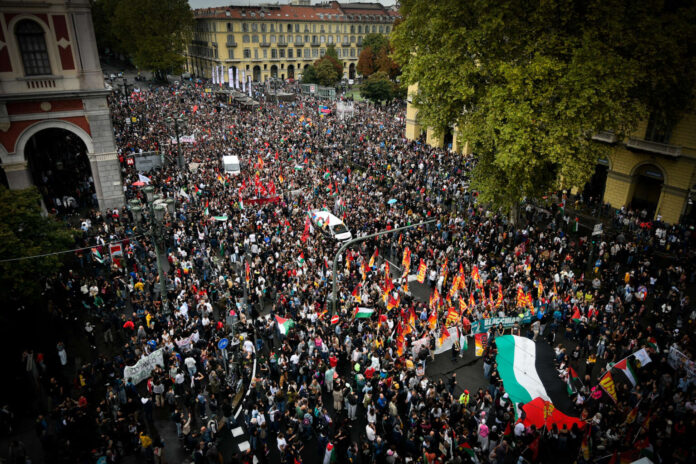
The national assembly “Kings or freedom” held on January 24–25 in Bologna is an expression of this articulation and complexity. The gathering was in part developed by the network against the Security Bill A Pieno Regime (At full Regime, an Italian pun on regime and speed, for which the same word can be used, ed), parallel to this one, and by the NoRearmEU circuit, activated in opposition to the Europeanist and militarist demonstration of March 15 in Rome. That assembly arose from an explicit awareness of the close connection between the authoritarian turn, rearmament, and inter-imperialist confrontation, asserting the need for an explicitly anti-campist alternative—one positioned against all imperialisms currently in play. The perspective advanced was that of a convergence of a broad front, form the mayor of Minneapolis to the Black Panther Party: in the Italian context, from sectors of the PD and Five Star Movement to social movements (including Askatasuna). There are, and can be, many criticisms of this perspective, beginning with a fundamental ambivalence—if not ambiguity—toward the campo largo and the democratic-front strategy. The role of AVS (Green and Left Alliance) and the social municipalist (an Italian network of activists and local lists, often in alliance with democratic and progressive forces, ed) present at the assembly underscore precisely this ambiguity. On the other hand, the limited weight, marginality, or absence of class-based and internationalist subjectivities within this circuit risks leaving insufficiently defended, articulated, and sustained the perspective of a politically independent development of social conflict. That is: on the one hand, the centrality of conflict within relations of production; on the other, a real autonomy of the working class. We refer both to politically organized forces and to those expressing the most advanced mobilizations in the current historical phase (such as the GKN Factory Collective, PCL and SA, Si Cobas, CUB, and other rank-and-file unions). In any case, it is precisely the nature of the united-front dynamic to bring together all the stratifications and subjectivities of the class, reflecting the mass expectation of the need for united resistance. Moreover, under the general conditions in which the workers’ movement currently finds itself, it is inevitable that any serious mass action—even if initially driven by partial demands—will place more general and fundamental issues on the agenda. It was precisely this unitary and determined spirit that animated the tide of September and October, sweeping away hesitation and organizational boundaries. Thus, even though the Bologna assembly represents only an approximation of that unitary spirit this process appears to us today as useful. Yes, it lacks the campist components, which see themselves as self-sufficient and seek to position themselves as the exclusive pole of aggregation), and include actors who aim to build democratic alliances and campo largo formations (sometimes with a preponderant role). But, on the one hand, it projects a mass-level alternative to campism; on the other, it nonetheless proposes a path of convergence and mobilization for the working class as a whole and for social movements, one that, in its immediate expression, is delimited around class and social movements. Within this framework, the proposal for a national mobilization on March 28, at the beginning of spring and after the justice referendum, represents a useful turning point to relaunch the possibility and perspective of a mass social opposition. Precisely because of the need to gain time, to obstruct the progressive authoritarian turn, and to weave a recomposition capable of developing working-class autonomy, it seems to us a priority today to pursue the relaunch of a movement against the government and its economic and social policies.
For this reason, we should avoid vanguardist paths. We have the impression that, instead, a reading is spreading across various advanced sectors—in the campist pole, in the Bologna circuits, and also among us—that the authoritarian turn is already a completed fact, that the Police State is by now fully operative, and that therefore the priority is to demonstrate resistance to repression starting from militant initiative, from the capacity to hold the streets and from the consequent level of confrontation. We had this impression after the massive demonstration of October 4, when some thought of developing that movement on the terrain of besieging the Israeli embassy. We have the same impression today in the dynamics of the response to repressive action in Turin—to the charges, the police deployments, and the militarization of Vanchiglia (a city neighborhood, in which The Askatasuna Center had his location, ed). Certainly, the reactionary government is attempting precisely now a repressive breakthrough, in a phase marked by the ebbing of the tide and the weakness of mass initiative revealed by the late-autumn strikes: multiplying charges and evictions of social centers, but also once again pushing beyond the limits of repressive action, with hundreds of tear gas canisters fired at body height, arrests, indiscriminate charges, and the blood of demonstrators. There are those who believe that, in the face of this offensive, resistance is not only a matter of triggering, organizing, and developing a mass reaction, but also of accompanying it with the organization of a section of the population—above all young people—who refuse to stay calm, who are increasingly unwilling to occupy centrist positions, and who are ready to draw a clear line. In this interpretation, it would no longer be a time for balancing acts. With what is at stake today, one must choose. And thus, alongside building mass demonstrations and communities, multiplying assemblies and spaces of discussion, some argue for taking a step forward by activating paths accessible to many, certainly in their diversity, but with the aim of breaking the banks of impotence and immobility, responding in the streets to the forced militarization that has now become the sole method through which institutions manage social crises. This position exists within the movement; it is an understandable reaction to the dynamics currently underway. However, we consider it mistaken—mistaken once again, we might say. We believe instead that today the priority is to broaden the popular response within a mass dynamic, and to weave, within the framework of this mass opposition, working class autonomy and independence. Precisely because of all the elements of complexity, gradualness, and political confusion, and precisely because of the stratification of the working class, we believe that such a strategy of response, on the one hand, facilitates the isolation and defeat of the vanguard, and on the other hand represents an opportunity for the reactionary right to advance its progressive authoritarian turn—otherwise struggling to find consent and concrete paths toward completion. It was precisely the experience of the September and October tide that showed how the violation of the Security Bill, of bans and red zones, acquires meaning and becomes a real advance in the balance of forces when it becomes a conscious, public, and collective objective and practice at the mass level.
For this reason, we believe it appropriate to develop in this spring an initiative capable of looking both toward the unity and development of a mass movement, and toward the necessity of bringing to the fore, within this movement, a perspective—an option, an alternative circuit—that is internationalist, working class-based, and anti-capitalist. This is why it seems useful to us to consider participating in the March 28 mobilization, including with blocs and contingents characterized by this orientation, avoiding dates or paths that are de facto alternative, while nonetheless building public moments of analysis, discussion, proposal, and mobilization capable of weaving—within the vanguard, but with a potential mass projection—this perspective of ours.