


In Rome, PuntoCritico, the P. Martignetti Documentation Center, and the magazine ‘Il cantiere’ closed out the old year and inaugurated the new one with an internationalist initiative against war and militarism.
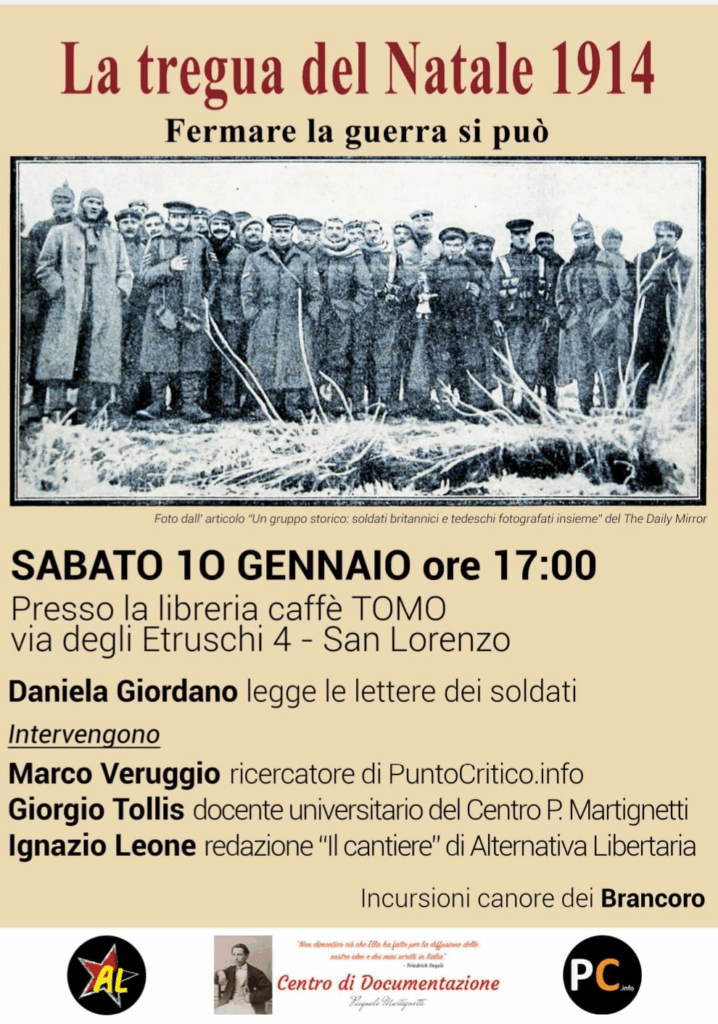
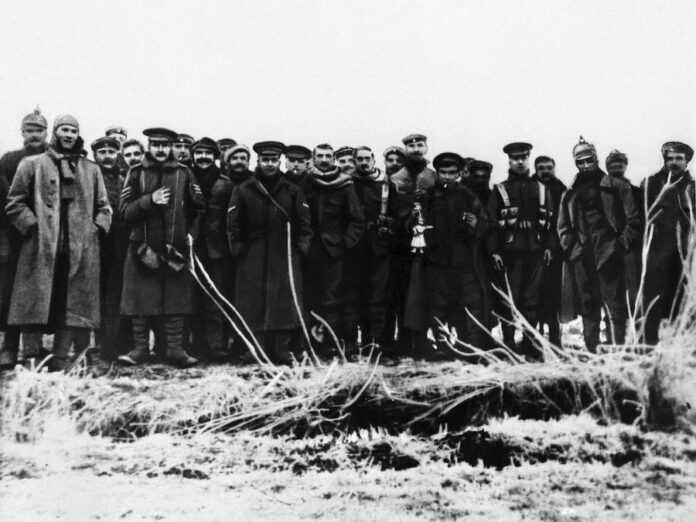
Given the way the new year began, the decision of closing out 2025 and inaugurating 2026 with a reenactment of the 1914 Christmas Truce, as we did in Rome together with the organizers of the Pasquale Martignetti Documentation Center and the magazine ‘Il cantiere’, proved to be a wise choice. This perhaps explains the success of the initiative held on January 10 at Tomo Libreria caffè, in the Roman district of San Lorenzo, a gathering place for university students and young nightlife, after the one held on December 4 at Zazie nel Metro, in the Pigneto district. Almost a hundred people attended the event, which recalled how, on that first Christmas of the war in the trenches, thousands of British, German, and French soldiers spontaneously decided to lay down their guns, leave the trenches, and celebrate Christmas together with those they had been shooting at just a few hours earlier. It was a choice that would provoke a harsh reaction from their generals and a bitter one also from a still unknown Austrian corporal: “Something like this should not happen in wartime. What has become of the German sense of honor?” That corporal’s name was Adolf Hitler.
On the podium of a small conference room, packed with attendees, so that some of whom had to follow the event from the adjoining room thanks to the sound system, Ignazio Leone, editor of ‘Il cantiere’, explained the significance of the initiative in the current political climate; Daniela Giordano, actress, moved the audience by reading two letters from soldiers who were protagonists of the Truce, alternating with historical notes by Marco Veruggio, editor of PuntoCritico. Finally, Giorgio Tollis, professor at Link University and representative of Martignetti, recalled, also quoting some passages from E.M. Remarque’s famous All Quiet on the Western Front, how in that first glimpse of 1914 there was a shift from almost total support for the war, even among the working classes, to a gradual awakening of consciousness. This explains the spontaneous initiative of those soldiers, but the teachings of social psychology also offer some food for thought: ‘in a situation of mortal danger such as that experienced by soldiers in the trenches, turning to one’s fellow men, because they are the only ones who can help you get out of it at that moment, is a basic biological stimulus’.

Between speeches, Brancoro, a “group of anti-fascist, anti-clerical, anti-sexist, and anti-militarist voices,” sang several anti-militarist songs from the period and closed with their reworked version of “Avanti o popolo” and the classic “Stornelli d’esilio” (Songs of Exile), best known for the first words of its chorus (“nostria patria il mondo intero” – our homeland is the whole world), a true anthem of libertarian internationalism written by the anarchist Pietro Gori in 1895.
“Thank you for organizing an event that brings together science and feelings,” said one of the spectators, “it deserves a much wider audience. Next year, I think you should do it again in a theater.” “I too would like to echo the words of the previous speaker,” said Luca, 27, “because I knew nothing about this episode, I had never heard about it at school, and you have opened up a whole new world for me.” This is a wish and a suggestion that we, together with the other organizers, cannot fail to take into account.
On this occasion, we also publish two letters from soldiers that were present in the 1914 Christmas Truce. Their account is truly remarkable
The Pte Heath letter
(Written in the trenches by Private Frederick W. Heath, transcribed by Marian Robson)
THE night closed in early – the ghostly shadows that haunt the trenches came to keep us company as we stood to arms. Under a pale moon, one could just see the grave-like rise of ground which marked the German trenches two hundred yards away. Fires in the English lines had died down, and only the squelch of the sodden boots in the slushy mud, the whispered orders of the officers and the NCOs, and the moan of the wind broke the silence of the night. The soldiers’ Christmas Eve had come at last, and it was hardly the time or place to feel grateful for it.
Memory in her shrine kept us in a trance of saddened silence. Back somewhere in England, the fires were burning in cosy rooms; in fancy I heard laughter and the thousand melodies of reunion on Christmas Eve. With overcoat thick with wet mud, hands cracked and sore with the frost, I leaned against the side of the trench, and, looking through my loophole, fixed weary eyes on the German trenches. Thoughts surged madly in my mind; but they had no sequence, no cohesion. Mostly they were of home as I had known it through the years that had brought me to this. I asked myself why I was in the trenches in misery at all, when I might have been in England warm and prosperous. That involuntary question was quickly answered. For is there not a multitude of houses in England, and has not someone to keep them intact? I thought of a shattered cottage in — , and felt glad that I was in the trenches. That cottage was once somebody’s home.
Still looking and dreaming, my eyes caught a flare in the darkness. A light in the enemy’s trenches was so rare at that hour that I passed a message down the line. I had hardly spoken when light after light sprang up along the German front. Then quite near our dug-outs, so near as to make me start and clutch my rifle, I heard a voice. there was no mistaking that voice with its guttural ring. With ears strained, I listened, and then, all down our line of trenches there came to our ears a greeting unique in war: “English soldier, English soldier, a merry Christmas, a merry Christmas!”
Friendly invitation
Following that salute boomed the invitation from those harsh voices: “Come out, English soldier; come out here to us.” For some little time we were cautious, and did not even answer. Officers, fearing treachery, ordered the men to be silent. But up and down our line one heard the men answering that Christmas greeting from the enemy. How could we resist wishing each other a Merry Christmas, even though we might be at each other’s throats immediately afterwards? So we kept up a running conversation with the Germans, all the while our hands ready on our rifles.
Blood and peace, enmity and fraternity – war’s most amazing paradox.
The night wore on to dawn – a night made easier by songs from the German trenches, the pipings of piccolos and from our broad lines laughter and Christmas carols. Not a shot was fired, except for down on our right, where the French artillery were at work.
Came the dawn, pencilling the sky with grey and pink. Under the early light we saw our foes moving recklessly about on top of their trenches. Here, indeed, was courage; no seeking the security of the shelter but a brazen invitation to us to shoot and kill with deadly certainty. But did we shoot? Not likely! We stood up ourselves and called benisons on the Germans. Then came the invitation to fall out of the trenches and meet half way.
Still cautious we hung back. Not so the others. They ran forward in little groups, with hands held up above their heads, asking us to do the same. Not for long could such an appeal be resisted – beside, was not the courage up to now all on one side? Jumping up onto the parapet, a few of us advanced to meet the on-coming Germans. Out went the hands and tightened in the grip of friendship.
Christmas had made the bitterest foes friends.
The Gift of Gifts
Here was no desire to kill, but just the wish of a few simple soldiers (and no one is quite so simple as a soldier) that on Christmas Day, at any rate, the force of fire should cease. We gave each other cigarettes and exchanged all manner of things. We wrote our names and addresses on the field service postcards, and exchanged them for German ones. We cut the buttons off our coats and took in exchange the Imperial Arms of Germany. But the gift of gifts was Christmas pudding. The sight of it made the Germans’ eyes grow wide with hungry wonder, and at the first bite of it they were our friends for ever. Given a sufficient quantity of Christmas puddings, every German in the trenches before ours would have surrendered.
And so we stayed together for a while and talked, even though all the time there was a strained feeling of suspicion which rather spoilt this Christmas armistice. We could not help remembering that we were enemies, even though we had shaken hands. We dare not advance too near their trenches lest we saw too much, nor could the Germans come beyond the barbed wire which lay before ours. After we had chatted, we turned back to our respective trenches for breakfast.
All through the day no shot was fired, and all we did was talk to each other and make confessions which, perhaps, were truer at that curious moment than in the normal times of war. How far this unofficial truce extended along the lines I do not know, but I do know that what I have written here applies to the — on our side and the 158th German Brigade, composed of Westphalians.
As I finish this short and scrappy description of a strangely human event, we are pouring rapid fire into the German trenches, and they are returning the compliment just as fiercely. Screeching through the air above us are the shattering shells of rival batteries of artillery. So we are back once more to the ordeal of fire.
Letter by private Tom to his sister Janet
| (source) |
My dear sister Janet,
It is 2:00 in the morning and most of our men are asleep in their dugouts—yet I could not sleep myself before writing to you of the wonderful events of Christmas Eve. In truth, what happened seems almost like a fairy tale, and if I hadn’t been through it myself, I would scarce believe it. Just imagine: While you and the family sang carols before the fire there in London, I did the same with enemy soldiers here on the battlefields of France!
As I wrote before, there has been little serious fighting of late. The first battles of the war left so many dead that both sides have held back until replacements could come from home. So we have mostly stayed in our trenches and waited.
But what a terrible waiting it has been! Knowing that any moment an artillery shell might land and explode beside us in the trench, killing or maiming several men. And in daylight not daring to lift our heads above ground, for fear of a sniper’s bullet.
And the rain—it has fallen almost daily. Of course, it collects right in our trenches, where we must bail it out with pots and pans. And with the rain has come mud—a good foot or more deep. It splatters and cakes everything, and constantly sucks at our boots. One new recruit got his feet stuck in it, and then his hands too when he tried to get out—just like in that American story of the tar baby!
Through all this, we couldn’t help feeling curious about the German soldiers across the way. After all, they faced the same dangers we did, and slogged about in the same muck. What’s more, their first trench was only 50 yards from ours. Between us lay No Man’s Land, bordered on both sides by barbed wire—yet they were close enough we sometimes heard their voices.
Of course, we hated them when they killed our friends. But other times, we joked about them and almost felt we had something in common. And now it seems they felt the same.
Just yesterday morning—Christmas Eve Day—we had our first good freeze. Cold as we were, we welcomed it, because at least the mud froze solid. Everything was tinged white with frost, while a bright sun shone over all. Perfect Christmas weather.
During the day, there was little shelling or rifle fire from either side. And as darkness fell on our Christmas Eve, the shooting stopped entirely. Our first complete silence in months! We hoped it might promise a peaceful holiday, but we didn’t count on it. We’d been told the Germans might attack and try to catch us off guard.
I went to the dugout to rest, and lying on my cot, I must have drifted asleep. All at once my friend John was shaking me awake, saying, “Come and see! See what the Germans are doing!” I grabbed my rifle, stumbled out into the trench, and stuck my head cautiously above the sandbags.
I never hope to see a stranger and more lovely sight. Clusters of tiny lights were shining all along the German line, left and right as far as the eye could see.
“What is it?” I asked in bewilderment, and John answered, “Christmas trees!”
And so it was. The Germans had placed Christmas trees in front of their trenches, lit by candle or lantern like beacons of good will.
And then we heard their voices raised in song.
Stille nacht, heilige nacht . . . .
This carol may not yet be familiar to us in Britain, but John knew it and translated: “Silent night, holy night.” I’ve never heard one lovelier—or more meaningful, in that quiet, clear night, its dark softened by a first-quarter moon.
When the song finished, the men in our trenches applauded. Yes, British soldiers applauding Germans! Then one of our own men started singing, and we all joined in.
The first Nowell, the angel did say . . . .
In truth, we sounded not nearly as good as the Germans, with their fine harmonies. But they responded with enthusiastic applause of their own and then began another.
O Tannenbaum, o Tannenbaum . . . .
Then we replied.
O come all ye faithful . . . .
But this time they joined in, singing the same words in Latin.
Adeste fideles . . . .
British and German harmonizing across No Man’s Land! I would have thought nothing could be more amazing—but what came next was more so.
“English, come over!” we heard one of them shout. “You no shoot, we no shoot.”
There in the trenches, we looked at each other in bewilderment. Then one of us shouted jokingly, “You come over here.”
To our astonishment, we saw two figures rise from the trench, climb over their barbed wire, and advance unprotected across No Man’s Land. One of them called, “Send officer to talk.”
I saw one of our men lift his rifle to the ready, and no doubt others did the same—but our captain called out, “Hold your fire.” Then he climbed out and went to meet the Germans halfway. We heard them talking, and a few minutes later, the captain came back with a German cigar in his mouth!
“We’ve agreed there will be no shooting before midnight tomorrow,” he announced. “But sentries are to remain on duty, and the rest of you, stay alert.”
Across the way, we could make out groups of two or three men starting out of trenches and coming toward us. Then some of us were climbing out too, and in minutes more, there we were in No Man’s Land, over a hundred soldiers and officers of each side, shaking hands with men we’d been trying to kill just hours earlier!
Before long a bonfire was built, and around it we mingled—British khaki and German grey. I must say, the Germans were the better dressed, with fresh uniforms for the holiday.
Only a couple of our men knew German, but more of the Germans knew English. I asked one of them why that was.
“Because many have worked in England!” he said. “Before all this, I was a waiter at the Hotel Cecil. Perhaps I waited on your table!”
“Perhaps you did!” I said, laughing.
He told me he had a girlfriend in London and that the war had interrupted their plans for marriage. I told him, “Don’t worry. We’ll have you beat by Easter, then you can come back and marry the girl.”
He laughed at that. Then he asked if I’d send her a postcard he’d give me later, and I promised I would.
Another German had been a porter at Victoria Station. He showed me a picture of his family back in Munich. His eldest sister was so lovely, I said I should like to meet her someday. He beamed and said he would like that very much and gave me his family’s address.
Even those who could not converse could still exchange gifts—our cigarettes for their cigars, our tea for their coffee, our corned beef for their sausage. Badges and buttons from uniforms changed owners, and one of our lads walked off with the infamous spiked helmet! I myself traded a jackknife for a leather equipment belt—a fine souvenir to show when I get home.
Newspapers too changed hands, and the Germans howled with laughter at ours. They assured us that France was finished and Russia nearly beaten too. We told them that was nonsense, and one of them said, “Well, you believe your newspapers and we’ll believe ours.”
Clearly they are lied to—yet after meeting these men, I wonder how truthful our own newspapers have been. These are not the “savage barbarians” we’ve read so much about. They are men with homes and families, hopes and fears, principles and, yes, love of country. In other words, men like ourselves. Why are we led to believe otherwise?
As it grew late, a few more songs were traded around the fire, and then all joined in for—I am not lying to you—“Auld Lang Syne.” Then we parted with promises to meet again tomorrow, and even some talk of a football match.
I was just starting back to the trenches when an older German clutched my arm. “My God,” he said, “why cannot we have peace and all go home?”
I told him gently, “That you must ask your emperor.”
He looked at me then, searchingly. “Perhaps, my friend. But also we must ask our hearts.”
And so, dear sister, tell me, has there ever been such a Christmas Eve in all history? And what does it all mean, this impossible befriending of enemies?
For the fighting here, of course, it means regrettably little. Decent fellows those soldiers may be, but they follow orders and we do the same. Besides, we are here to stop their army and send it home, and never could we shirk that duty.
Still, one cannot help imagine what would happen if the spirit shown here were caught by the nations of the world. Of course, disputes must always arise. But what if our leaders were to offer well wishes in place of warnings? Songs in place of slurs? Presents in place of reprisals? Would not all war end at once?
All nations say they want peace. Yet on this Christmas morning, I wonder if we want it quite enough.
| Your loving brother, Tom |