

In Syria, the war did not end when al-Sharaa toppled Assad and came to power; it only changed costume. The Damascus authorities want to establish a unitary regime across the country; the SDF (the Kurdish Syrian Defence Forces) wants to formalize the status of Rojava, the autonomous region it built through long years of war; Ankara views any Kurdish polity on its border, even an autonomous one, as a security threat; and the United States tries to establish dominance while keeping risks on the ground at a “manageable” level.
A four-day ceasefire, the Hasakah bargaining, and a prison-and-camp crisis
On January 20, 2026, Syria’s Ministry of Defense announced a four-day ceasefire, set to take effect at 20:00. According to Reuters, Damascus sees this period as a window to finalize an “integration plan” specifically for the city of Hasakah, and expects steps from the SDF, including proposing names for positions such as deputy minister of defense in Damascus. Al Jazeera’s live feed similarly notes that the entry of state forces into Hasakah is being tied to acceptance of the plan during the ceasefire period.
Over this “window,” a security nightmare is unfolding, regarding ISIS (Islamic State) detainees. Kurdish forces played a key role in the fight against ISIS and are responsible for keeping a big number of prisoners from that fight in their area. Reuters reported that Syria’s Interior Ministry said roughly 120 ISIS prisoners escaped from a prison in al-Shaddadi, while Kurdish sources claimed the number was much higher. Associated Press reports that escapes have come onto the agenda amid the vacuum created by fighting and withdrawals; that Damascus accuses the SDF of “releasing detainees,” while the SDF does not confirm this and instead talks about “international indifference toward the issue of the ISIS terrorist organization and the failure of the international community to assume its responsibilities in addressing this serious matter.”The Guardian also underscores both the dispute over numbers and the mutual accusations.
A clear conclusion follows: there is no verified “official release” statement confirming the claim that “ISIS members were freed.” What we are seeing is a crisis in which official authorities and actors on the ground blame one another via narratives of “escape/abduction/neglect.”
On the same day, Guardian reported that the SDF changed the security arrangements around the al-Hol camp, further intensifying tensions and the debate over “escapes.” This shows that the bargaining over “integration” is not only taking place at the negotiating table, but also at the gates of prisons.
Mazloum Abdi’s line: “Stop the bloodshed,” but with a “red line”
In this equation, the statements of SDF Commander-in-Chief Mazloum Abdi reveal both intent and fragility. Reuters’ January 18 report on the agreement says Abdi confirmed that the SDF accepted withdrawing from two Arab-majority provinces (Deir ez-Zor and Raqqa). In a video statement, Abdi argued that this decision aimed to prevent further “bloodshed.” Earlier, Abdi had also announced that they would withdraw from eastern Aleppo and shift their forces to the east of the Euphrates.
This rhetoric implies that the SDF is being pushed from a structure that holds broad territory as an “administrative-military” system into a defensive posture squeezed toward more Kurdish-majority areas. Domestically, this makes the question even more acute: is “integration” a genuine compromise, or a dismantling operation? Because the deeper the withdrawal on the ground, the greater the risk that the “individual integration” formula demanded at the table will erode the SDF’s collective capacity.
Damascus’ objective: centralization, a fast timetable, low tolerance
The Damascus authorities appear to have tied the “return of state authority” to a fast timetable. Declaring a four-day ceasefire is, in effect, a sign of impatience with protracted negotiations. Simultaneously, military advances, administrative appointments, and conditions attached to the “integration plan” are being activated. This is the classic postwar state-building reflex: seize the territory first, build the institution next, then reduce the interlocutor to the level of the “individual.”
But in a society like Syria, this reflex points not to peace, but an “administrative procedure of surrender.”
The U.S.’s new weight: “the mission is over” for the SDF, a “window of opportunity” for Damascus
Now to Washington. Reuters reports that the U.S. line on the ground has shifted toward a new axis that increases pressure on the SDF for “individual integration,” and that the agreement is being read through a framework supported both by Turkey and the United States. Tom Barrack’s (US Ambassador to Turkey) statement on X made this shift even more visible. Barrack argues that the SDF’s “core anti-ISIS role” has effectively ended, and that the greatest opportunity for Kurds is “full integration into a unified Syria” under Ahmed al-Sharaa’s transition process, which could open channels for citizenship, cultural protections, and political participation.
This rhetoric points to a U.S. acting less as a “guarantor of rights” for the Kurds and more as a “nation-builder”: telling the SDF “the partnership era is over,” telling Damascus “the responsibility is yours,” and telling Ankara “we are aligned with your concerns.” This policy in effect dumps the Kurds, leaving them in the hands of the new Syrian regime, while not solving any of their problems.
Ankara’s internal and external line: pressure in Syria, a test for the peace process at home
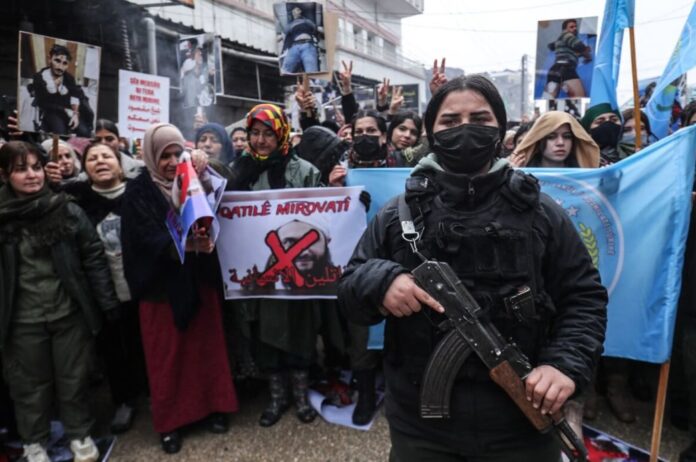
For Ankara, the SDF file is less “Syria policy” than an extension of “internal security.” It is no coincidence that border-area protests have entered the agenda so sharply today. The DEM (Peoples’ Equality and Democracy) Party, whose weight largely comes from the political wing of the Kurdish freedom movement, signaled its stance on Rojava by holding an Executive Meeting in a border province Nusaybin. At the same time, we heard in the news that tens of thousands of people were marching toward the border, and that some crossed into Rojava with the aim to protect it.
Reuters wrote that Turkish authorities launched an investigation over allegations that Turkish flags were burned during protests on the Nusaybin–Qamishlo line in the Turkish-Syrian border; police used tear gas and water cannons; and the governing camp framed the protests as “targeting national unity.”
The question is how this affects the climate of “peace talks” underway in Turkey. Reuters noted in the same report that Turkey is continuing talks with the PKK aimed at disarmament and dissolution. The debate constructed around the recent border protests and the symbol of the “flag,” however, presses on the peace process at its weakest point. The rise in nationalism that the Erdogan regime inflames, narrows the government’s “room to negotiate” narrows. DEM politics may be criminalized; and reflexes about “security” can harden both domestically and on the Syria front. In other words, the Rojava theatre is becoming a litmus test for the Kurdish peace file in Ankara.
Israel’s position: the Kurdish card, pressure on Damascus, a message to Washington
On the Israeli front, a more visible line has emerged in recent weeks: Israeli Foreign Minister Gideon Sa’ar condemned attacks on Kurdish neighborhoods in Aleppo in early January as “serious and dangerous,” emphasizing that “the West owes Kurds a debt of honor.” This discourse does two things: it sends Damascus a message that “your legitimacy is fragile,” and signals to Washington that “the Kurds are not alone.” Whether these statements will be translated into any kind of practical support and on what level remains to be seen.
A new detail reinforcing this line has also appeared: Al Arabiya reported that an official from Syria’s Kurdish administration said they are in contact with Israel and are open to support “from any source.”
The political meaning of the “ISIS file”: a security crisis, a legitimacy tool, a bargaining lever
Today’s debate about “escapes” is not merely a prison incident. Damascus can generate legitimacy to accelerate the so-called “integration” by accusing the SDF of “turning a blind eye” to escapes. The SDF, under pressure from attacks and withdrawals, can try to reopen space with Washington by complaining about “international indifference.” Meanwhile, the real risk is this: every escape increases the likelihood of ISIS regrouping and hardens the “security” argument for all parties. In today’s Syrian politics, security is not only an objective, it is also the most effective language of negotiation.
What is the outlook?
If “integration” is not a process that constitutionally guarantees local governance autonomy/independence and pluralistic life (language and cultural rights), but instead is operated as a disciplinary mechanism that dismantles institutions and reduces people “one by one,” then what is called a “ceasefire” today will become the gateway to a broader instability tomorrow.
What falls to us is to expose these relations, starting with those of our own oppressor nations, and to unconditionally defend the right of nations to self-determination, without leaving the Middle East to the domination of imperialism and reactionary forces.