

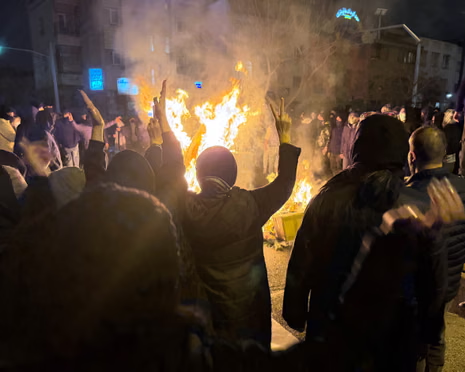
Iran’s nationwide uprising continues amid mounting evidence of a systematic and deadly campaign by the state to crush popular resistance. Reports emerging from hospitals, despite a near-total internet blackout, reveal the scale of violence being unleashed against unarmed protesters—overwhelmingly drawn from the working class, youth, and the urban poor.
Medical staff at two hospitals in Rasht, in northern Iran, and Tehran, the capital city, have confirmed that at least 110 bodies were transferred to these facilities alone. Doctors inside the country report that on January 8 and 9, numerous patients arrived with live-ammunition gunshot wounds to the head, neck, and eyes—clear indications of intentional lethal force rather than crowd control.
Human rights defenders had warned that the nationwide internet shutdown would be used as a cover for mass killings. Under these conditions, obtaining reliable nationwide figures is impossible. Current estimates of the death toll range from hundreds to potentially thousands, reflecting not exaggeration, but the deliberate obscuring of reality by the state.
According to multiple external sources, the Iranian regime has reportedly sought to reinforce its repressive apparatus by drawing on foreign paramilitary forces, including members of Lebanon’s Hezbollah and Iraq’s Hashed al-Shabi. While independent verification remains difficult, such reports underscore the regime’s growing dependence on militarised networks to maintain power against its own population.
Yet repression is not the only danger confronting this uprising. As blood is shed in the streets, monarchist and royalist factions, long detached from the lived realities of Iran’s working people, are attempting to politically hijack the revolt. These forces seek to redirect the grassroots, class-driven uprising into a project aligned with elite restoration and foreign patronage.
The role of the United States has been particularly revealing. While issuing statements of concern for “human rights,” Washington has simultaneously signalled implicit support for royalist currents, reproducing a familiar imperial strategy: backing compliant elites while presenting intervention as solidarity. This double game is neither new nor misunderstood by Iranians.
Iran’s modern history, from 1953, is the best justification of people’s fear and disgust of any foreign state intervention. At that time, America and England engineered a coup d’etat to overthrow the first democratically elected Prime Minister, Mosaddeq and enforced a dictatorship on the Iranian people that continued until 1979. They again orchestrated another hijacking of the revolt by the clergy-capitalist state that continues to rule the country up until now. They brought incredible economic, political and social consequences to Iran and have created a bankrupt country whose price is paid by the majority of the working class and urban poor of the society, while a small oligarchic class lives in unbelievable luxury.
The monarchists are attempting to manipulate the situation in their favour. They do not understand that what has driven millions into the streets is not nostalgia for past rulers, but decades of economic dispossession, rampant inequality, privatisation, unemployment, inflation, and the militarisation of everyday life. The Islamic Republic has functioned not as an alternative to imperial domination, but as a local manager of capital accumulation and repression, enriching a narrow ruling layer while condemning vast sections of society to precarity.
Sanctions, far from weakening authoritarianism, have deepened class polarisation, allowing the regime to shift the burden of economic collapse onto workers, pensioners, and the poor while expanding its security apparatus. At the same time, Western governments instrumentalise human rights discourse selectively—invoking it loudly when it serves geopolitical pressure and quietly discarding it when it threatens strategic interests. This hypocrisy has been fully internalised by Iranians who have lived through war, embargo, and covert intervention.
The danger now is that the uprising’s radical potential—its capacity to articulate demands for social justice, democratic control, and economic redistribution—will be neutralised by forces offering only a change of flag or figurehead.
Monarchist currents, amplified disproportionately by foreign media and exile networks, present themselves as a ready-made “alternative,” while remaining fundamentally hostile to popular participation and to working-class self-organisation. Their project is not emancipation, but restoration under new branding.
Against this backdrop, the Iranian people face a dual struggle: resisting a state that kills to survive, and rejecting external and internal actors who seek to discipline the uprising into safe, controllable outcomes. The most dangerous moment for any revolutionary movement is not only when it is attacked by power, but when it is spoken for—when its voice is replaced by intermediaries claiming legitimacy without accountability.
What endures, however, is the political consciousness forged in struggle. Strikes, neighbourhood resistance, student mobilisations, and grassroots solidarity networks—often ignored by international coverage—point toward an alternative political horizon rooted in collective power rather than elite negotiation. These forms of organisation, fragile yet persistent, represent the embryo of a politics that neither kneels before clerical authority nor appeals to imperial guardians.
History does not repeat mechanically, but it does issue warnings. Iran’s past revolutions were derailed when popular movements were isolated, fragmented, or subordinated to external interests. The lesson emerging once again from the streets is uncompromising: freedom cannot be delivered by executioners, nor negotiated by exiles backed by foreign states.
As repression intensifies and narratives multiply, the central task remains clear—for Iranians and for those in solidarity abroad: to defend the independence, class character, and democratic substance of this uprising. Anything less risks turning yet another mass sacrifice into a footnote in the long record of betrayed revolutions.
The Iranian Revolutionary Marxists’ Tendency
11/01/2026