

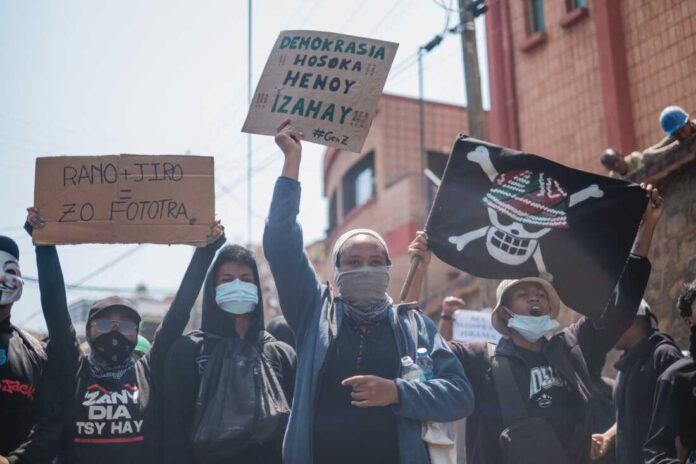
Over the last couple of years Gen Z (i.e. the youth who are now in their teens and 20s) has been out on the streets, leading struggles against war and the genocide in Gaza, against corruption and exploitation, pushing governments to retreat or even forcing them to go down. From the Andes to the Himalayas, from the Indian ocean to the Pacific, from South America to Asia, there are anti-government demos with similar characteristics.
While the West is shaken by the huge pro Palestine movement, in Asia the uprisings have been characterised as the Asian Spring and similar movements have appeared in Africa and Latin America. They are not coordinated, they are not consciously communicating with each other, but they have similar characteristics and are using many similar symbols.
The latest one is the protest in Bulgaria, where Gen Z played a role in bringing down the government and taking back its bill to increase taxes, in the beginning of December.
Some of the protests that reached the media, even though they haven’t been given the credit that they deserved, were:
- In Bangladesh where the protests were widely cited as the first successful Gen Z revolution, inspiring similar movements across Asia.
- In Nepal, where protests initially triggered by a social media ban escalated into a widespread anti-corruption social revolt that led to the government’s downfall.
- In Madagascar where protests over water and power shortages evolved into a larger movement against corruption and bad governance, which led to the president fleeing the country.
- In Kenya where Gen Z led protests against a new finance bill with tax hikes drew global attention to youth frustration.
- In Peru, where protests were sparked by a pension reform but grew into a broader rebellion against corruption and crime, resulting in the president’s impeachment.
- In Morocco, where protests organized by the “Gen Z 212” movement demanded better public services, forcing the government to enact reforms to increase political participation and social spending.
Expected to be poorer than their parents
Gen Z, born roughly between the mid-1990s and the early 2010s, grew up during two economic crashes (2008, 2020), climate disasters, rising authoritarianism, wars, corruption scandals and widening inequality and exploitation.
Gen Z is the first generation in the decades after the second world war that is expected to be poorer than their parents on an international level, including in the industrially developed countries of the West.
They face high youth unemployment while when they get a job it usually is gig/unstable jobs replacing permanent work. Their wages cannot keep up with inflation and the rising cost of living (especially basic needs like food, utilities, transport).
They face impossible housing prices, especially in big cities and as a result the majority cannot afford to move out of their parents house, start their own families, let alone own their home, even when working full time.
The housing crisis is one of the biggest and defining issues as we see global patterns of unaffordable rentals everywhere, massive corporate landlords pushing prices up, student housing shortages and, even worse, homelessness among young people sharply rising (US, UK, Australia) and being normalised!
Gen Z is already experiencing climate and environmental breakdown. Water shortages, extreme heat, food insecurity, forced migration, collapsing biodiversity. For many, the climate crisis is not “future” – it is happening now. In the last few years we have seen massive heatwaves in India, Pakistan and the Middle East, floods in Southeast Asia and in Europe, wildfires in Canada, Greece, Australia, toxic air pollution in South Asia. This shapes a generation who feel they have been handed a burning planet.
Raised fully online
Gen Z is the first generation “raised” fully online. This gives them the advantage in navigating and organising in the digitalised world, however it has some serious impacts in their lives. Gen Z suffers from shortened attention spans, reduced real-world socialization, constant surveillance, online harassment and data exploitation. They are prone to digital overload and algorithm-driven radicalization (the online “bubble effect” or “filter bubble” in which the algorithm only shows you content that you agree with, creating a digital echo chamber), which later can be misleading, but at the same time may also make this new generation come into contact with protests and activism.
This economic uncertainty, the extreme academic pressure that Gen Z is facing, climate anxiety, political instability and wars, combined, on a more personal level with social media “pressure”, cyberbullying and loneliness, create a huge mental health crisis. Gen Z consistently reports the highest levels of depression, anxiety, and burnout globally.
Using different tools
Being fully online, and especially since for many of them their adulthood was during Covid and the massive lockdowns, they are organising with the tools that they have at hand.
Gen Z organises through social media, especially TikTok, Instagram, and Twitter/X, using as tools memes, short videos, and viral campaigns. They are organised in a “decentralised” way – there are no single leaders in their movements.
Their struggles are interconnected: Climate justice and indigenous rights; Feminism and LGBTQ rights; Anti-racism; Anti-capitalism, Anti-colonialism and peace movements; while at the same time they have strong anti-authoritarian and anti-capitalist leanings. They are against capitalist exploitation, state militarism, surveillance, police power and corporate influence – although at the same they do not have an alternative proposal to the current social system.
More than one international movement
Gen Z movements are not restricted to the ones mentioned above. One of the most characteristic ones, from the previous period, was the Fridays for Future movement about climate justice. Then, GenZ, in its teens, was flooding the streets. Their movement was sparked by Greta Thunberg in Sweden, but then quickly took a global dimension, with strong calls for systemic change, not personal lifestyle fixes.
A couple of years later Gen Z played an important role in the globalization of the Black Lives Matter movement.
In Asia, in the pro-democracy movement in Hong Kong in 2019, Gen Z “became water” (the central slogan it used) with decentralised, fast and fluid protests organised through “Telegram”. In Thailand, in the following year, Gen Z led an anti-monarchy, pro-democracy movement which was unthinkable in earlier times. In 2021, in Myanmar they resisted the Military Coup, not just with protests but also with strikes, strike committees and community based resistance. In South Korea they revived radicalised feminist activism online and in the streets, and in Philippines Gen Z struggled against the Marcos-Duterte authoritarian dynasty. Last but not least in China in 2022 they led the anti-overwork movement –the “lying flat” and “let it rot” movement– the quiet resistance to the pressure of the regime.
These movements came after the defeats of the movements sparked by the global financial crisis of 2008-9, and the sell-outs by new left parties like SYRIZA in Greece and Podemos in Spain. They can be seen as part of the new attempts by the working class to organise and fight back, renewing the hope of struggle against the evils of capitalism.
Political Disillusionment and the “absence” of the Left
However, despite the enthusiasm that Gen Z is creating to the older generations, they themselves often feel disillusioned. They feel the system is rotten, democracy is failing them and politicians don’t represent their interests. This leads either to radicalization (left-wing or right-wing depending on context) or deep cynicism.
The movements they lead raise demands that the Left should have embraced and fought for. However the Left itself is in crisis in the last decades, having failed the test of fighting against neoliberal policies never mind for an alternative socialist society, particularly since the 2008-9 global economic crisis.
Gen Z’s struggles need to be linked to the idea of building new left forces. The capitalists and their institutions have created the multiple crises we are experiencing and they obviously cannot solve the economic and social problems that arise. The answer to the crises we face in society can only come from the Left – the capitalists care only for their interests and the right wing and far right parties have their own even more conservative agenda leading to an even more dystopian future.
Gen Z knows what they don’t want – but not how to bring about change
Gen Z is a well informed generation and they know what they don’t want. They have demands and organise strong movements that make them heard. However they don’t know how to change what they don’t like. Therefore, on many occasions, they lay their hopes in capitalist institutions that are the other side of the same coin they are fighting against – and actually, in some cases, they can be even more conservative and oppressive.
For example in Nepal, the youth proposed who should be the interim prime minister (which in itself is quite impressive) through “Discord” and actually chose a bureaucrat that supported the movement but who did not have any conception of or desire to change anything.
In Madagascar the protests were ended by a military coup, after the president fled the country as a result of the protests. Many protesters welcomed the army’s intervention — seeing it as the only remaining institution capable of removing the old regime given its collapse and alleged corruption.
In Morocco the protests –led by the loosely organized youth movement GenZ 212– with demands for better public services (healthcare, education), jobs for the youth, end to corruption and more social justice, finally explicitly addressed the King! Even though the King announced “social reform priorities” paying lip service to the demands of the movement without recognising it, however, these “priorities” were suggestions rather than laws and did nothing to change the situation of Gen Z.
All over the planet, the movements of Gen Z have faced serious obstacles, state repression, legal crackdowns, etc. In some countries the governments use the unrest as a pretext to tighten control (military in civilian roles, restrictive laws, surveillance) — which might reverse the initial gains of the movement. It may even facilitate the rise of far-right wing forces, or forces supported by and in the service of imperialist powers, to take over.
Gen Z and the Left internationally
As long as these movements do not get organised in the direction of creating new political formations that represent their interests and radical demands against the system, and which at the same time are under their democratic control, all their gains will be temporary or superficial.
The Left internationally has a major responsibility towards these movements. Gen Z has proven that they are angry and ready to fight. They are the current and future workers therefore their movements should be seen, listened, approached and supported. But this comes into conflict with what characterizes the majority of the parties of the Left, old and new, internationally: the vast majority of these parties have capitulated to capitalism and the “market forces”, and when in power they are in the service of the ruling class.
Of course there are sections of the Left, new and radical currents, that are under development, that can see the significance of GenZ’s mobilizations. They have the task to intervene and participate in the Gen Z movements –-not to organise for them, or instead of them, but with them and by them– in an effort to build new mass left parties that will challenge the system and fight for an alternative society. Because at the end of the day Gen Z are the hope for a different future, for a better society, for a democratic socialist society.