

Unprecedented mass demonstrations in Bulgaria have forced the government to withdraw the draft budget for 2026 and resign, amid political instability and ahead of the country’s planned entry into the Eurozone.
The budget that broke the camel’s back
On November 21st, the draft state budget for 2026 was passed on first reading by the Parliament. This was intended to be the first budget denominated in Euros, as Bulgaria is set to join the Eurozone on January 1st, 2026.
Despite being presented as “socially-oriented” and including some wage increases, the draft provoked an immediate public backlash as it significantly increased the country’s deficit and debt to very high levels without directing those funds toward the lower social strata. Entry into the Euro was supposedly meant to be combined with income increases. Instead, it appeared that while funds for defense expenditures were secured, wage increases were low (relative to the rising cost of living in recent years). New measures were also announced that would hit the middle class (an increase in social security contributions that would impose a great cost on small and medium-sized enterprises, which constitute 98.8% of businesses and employ 74% of the workforce) (source). The message was clear: the working and middle classes would bear the budget’s burden without seeing a significant improvement in their living standards.
The warning of November 26
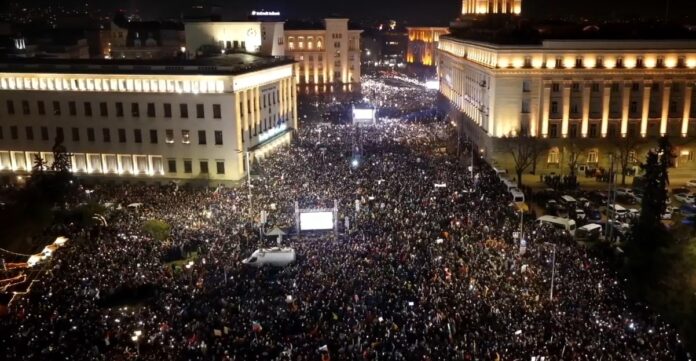
The first major sign of unrest appeared on the afternoon of Wednesday, November 26. Over 20,000 demonstrators gathered in Sofia at the “Triangle of Power” to demonstrate against the draft. Protesters encircled the Parliament, preventing the members of parliament who were in session at the time from leaving. Equally dynamic rallies took place in other major cities, such as Plovdiv and Varna.
The initial initiative for the mobilization belonged to the opposition coalition “We Continue the Change–Democratic Bulgaria” (PP-DB), but participation transcended party lines, giving the demonstrations a broader, movement-type character.
Although the budget was the immediate cause, the demands quickly expanded. Protesters called for the budget not to be designed “from above” but after consultation with society, and they also demanded an end to corruption. It should be noted that, according to data from Transparency International, Bulgaria is the second most corrupt country in the EU. (source) The MP and businessman Delyan Peevski and former Prime Minister Boyko Borissov came under fire, as they are seen by many people as being inseparable from oligarchy and corruption. Furthermore, there was a strong element of Euroskepticism, as approximately 50% of Bulgarians remain negative towards adopting the Euro (source). One of the strongest demands, however, was the resignation of the government and the calling of new elections.
The Mockery That Triggered the Explosion
Under pressure from the events, the government initially announced that it would proceed with changes to the budget after consulting with trade unions and bosses organisations. However, it later retracted this promise (source). This move infuriated the public, leading to the organization of a new, even larger demonstration for Monday, December 1st.
Adding fuel to the fire was the arrogance of Boyko Borissov, leader of the ruling GERB party. In a statement that went viral, Borissov dismissed the gravity of the crisis, remarking that he would not miss a match of his favorite team, Real Madrid, to deal with the demonstrations.
The mass mobilization of December 1
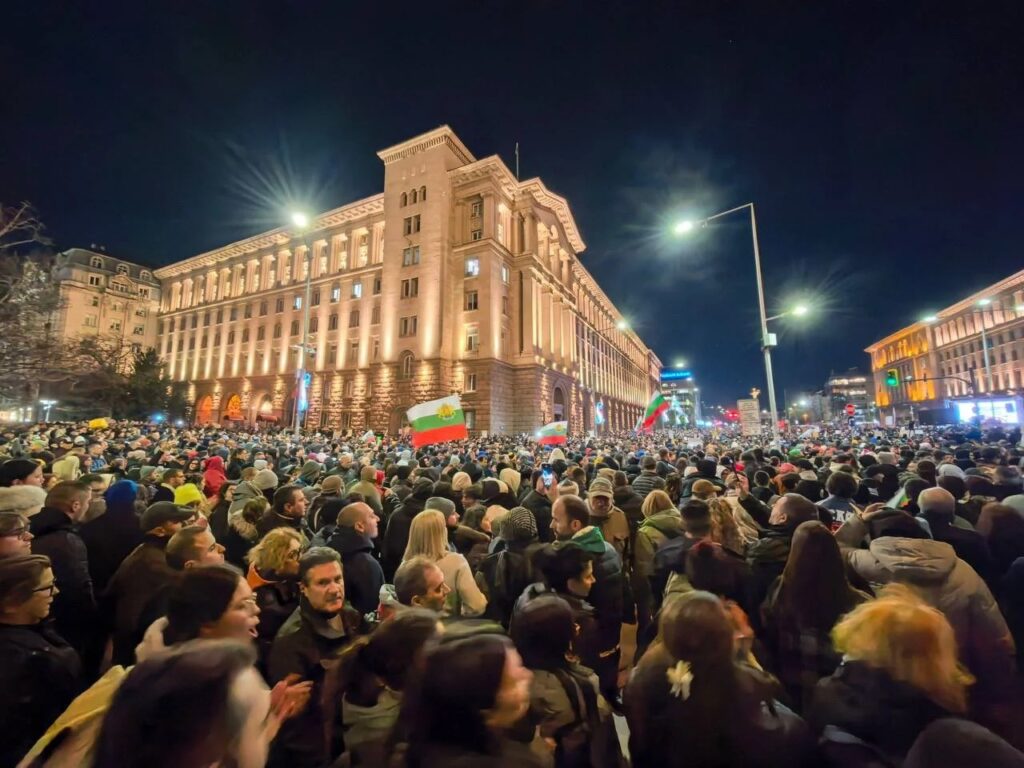
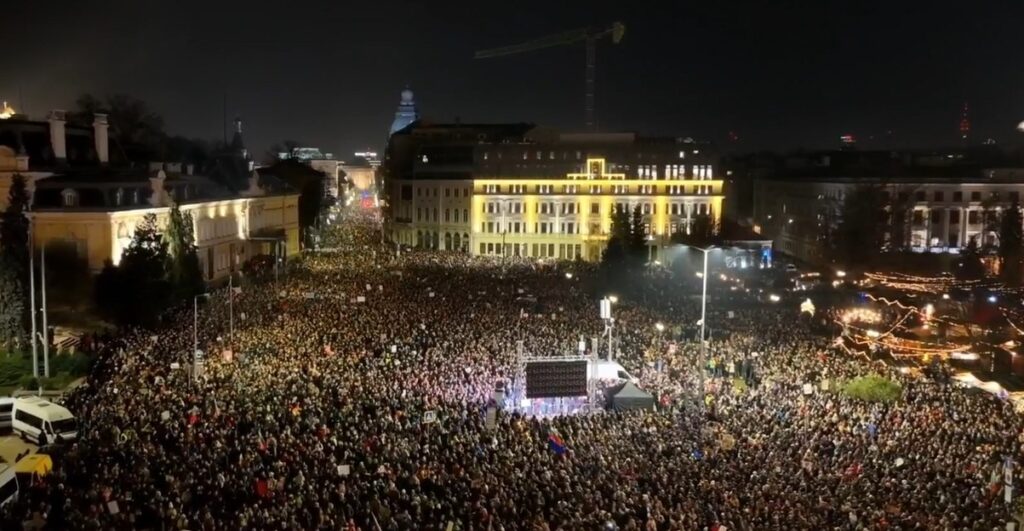
The enraged Bulgarian people flooded the streets again on the afternoon of December 1st. This time the demonstrations were even bigger: in Sofia, estimates suggest more than 50,000 protesters participated. The mobilizations spread across the country: Varna, Plovdiv, Burgas, Stara Zagora, Dobrich, Sliven, Veliko Tarnovo, Shumen, Ruse, Lovech, Blagoevgrad, and Gotse Delchev were just some of the cities that were “overwhelmed.”
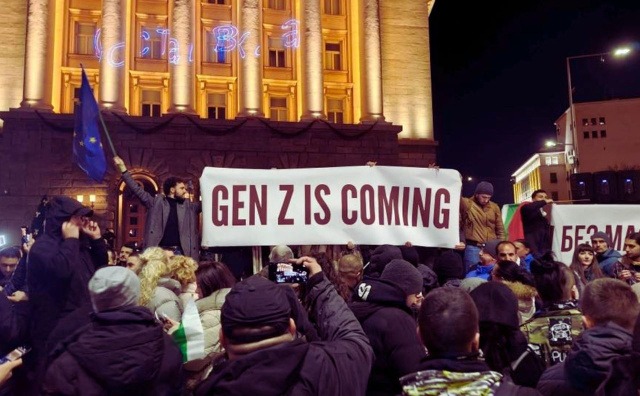
The mass participation was unprecedented and can only be compared to the historical demonstrations of the 1990s that led to the fall of Stalinism. This time, the dominant demand was the resignation of the government and the calling of new elections. A striking element was the participation of young people, specifically Gen Z (those born between 1997-2012). The youth organized spontaneously via TikTok and Instagram, driven by the pervasive feeling that their future was being sold out.
During the demonstrations, there were some limited violent incidents, but the media and government representatives attempted to focus on these to discredit the movement. This tactic failed, however, as the sheer size of the crowd and videos on social media revealed the reality. A characteristic example is the television channel bTV, which was forced after public outcry to correct the description of the masked individuals from “protesters” to “provocateurs.”
The Government is losing ground
Faced with unyielding pressure, the government submitted a request to withdraw the draft state budget, along with the budgets for the National Health Insurance Fund (NHIF) and State Social Insurance (SSO). The withdrawal was voted unanimously by the 201 present MPs (out of 240 total) (source). At the same time, Minister of Finance Temenuzhka Petkova scheduled discussions with representatives of unions and bosses organizations for the readjustment of the plan.
Despite the chaos, GERB Chair Boyko Borissov initially remained defiant, stating that the coalition would not resign and would stay in power to ensure Eurozone integration. (source)
The opposition coalition “We Continue the Change–Democratic Bulgaria,” attempting to capitalize on the government’s weakness, submitted a motion of no-confidence on December 5th (source), the ARF (Alliance for Rights and Freedoms) and MECH (Morality, Unity, Honor) supported the motion, so a no-confidence vote was going to be held on Thursday, December 11.
The demand for resignation and new Protests
The government withdrew the budget proposal, but the demands had already broadened; the main demands of the protesters were already the resignation of the ruling coalition, new fair elections, and the end of corruption. So on Wednesday, December 10th, in anticipation of the no-confidence vote, new, even more massive protests took place.
In Sofia, tens of thousands protesters gathered in the triangle of power, undeniably more than the last protest. Students held their own protests that later joined the main demonstration. Laser projections on the facade of the National Assembly displayed messages such as “Resignation”, “Mafia Out” and “For Fair Elections”. Massive demonstrations were also held in other major cities across the country, and in many European cities with large Bulgarian communities, like Brussels and Vienna (source).
Government defeated by protests
The unstable government coalition could no longer ignore the unprecedented scale of the mass protests.
PM Rosen Zhelyazkov announced his resignation on television shortly before parliament had been due to vote on the no-confidence motion. The vote went ahead anyway, but the motion failed (it was voted by 106 MPs, while a 121 majority was needed- the government MPs boycotted the vote). It was the sixth failed no-confidence vote since the forming of the government on January 16, 2025.
As the situation currently stands, the most probable outcome is the scheduling of new snap elections, demonstrating that the collective power of the people can successfully overthrow a government despite parliamentary support.
The political stalemate
The draft budget ignited the uproar, but the underlying popular dissatisfaction had deeper roots. The political situation in Bulgaria has been characterized by chronic instability. Since 2021, when mass demonstrations led to the resignation of the then-Borissov government, 7 elections have been held. The short-lived coalitions of centrist and right-wing parties are unable to offer a way forward for the bulgarian people. The current ruling coalition is composed of Borissov’s right-wing GERB, the Socialists (BSP), and the populist ‘There Is Such A People’ (ITN), with the controversial support of Peevski (leader of the Movement for Rights and Freedoms party, which belongs to the liberal European group and is mainly based on Muslim voters), a fact that highlights the extent of the dysfunction.
These policies of the Socialist Party (BSP—a successor to the Stalinist Bulgarian Communist Party) as well as many internal problems have caused the dissatisfaction of its supporters. In previous years, its percentages ranged between 15% and 30%, while in the last elections it gathered only 7.32%.
The far-right appears to be the main beneficiary of the current crisis. Parties such as “Revival,” “Greatness,” and MECH (Morality, Unity, Honor) are exploiting dissatisfaction with the Eurozone and poverty and are gaining ground. They have already organized many anti-European demonstrations throughout 2025 and actively participated in the recent mobilizations. “Revival,” in fact, was the third largest party in the last elections and constitutes a strong parliamentary force.
The opposition coalition “We Continue the Change–Democratic Bulgaria” (PP-DB), although it appears to have organized the demonstrations, does not have great appeal to the masses. Its political agenda centers around Eurozone accession and cracking down on corruption, but does not differ much from the ruling coalition.
Structural Problems Remain
The massive protests achieved a significant victory in toppling the government and halting the budget, but the fight is far from over.
Austerity and corruption are deeply impacting daily life, fueling widespread anxiety. Concurrently, concerns about the Euro are intensifying: citizens fear that the currency change will lead to price hikes, a reduction in purchasing power, and the loss of national monetary sovereignty. ECB President Christine Lagarde has already warned of a possible “temporary” jump in inflation during the first months of adoption. These fears are not unfounded, as this is the usual scenario for countries adopting the Euro.
The prospect of new, fair elections offers little solace, as the political landscape is characterized by a notable deficit of viable alternatives. This is exacerbated by the glaring absence of a cohesive Left force. The situation is becoming critical, especially given the underlying danger of the far-right gaining ground—a force that already wields significant influence. Only a mass workers party can galvanize the people, organize the struggle, and offer a credible solution to the current impasse.
It is essential that the spontaneous movement of youth and workers does not dissipate into dead-end compromises. Crucially, the upcoming elections should not lull the public into a false sense of security, as fundamental improvements to the situation are highly unlikely without sustained, independent pressure from below. Assemblies and committees must be formed to organize the rank-and-file, draw the necessary conclusions, and put forward a political program of confrontation with the government and the dictates of the EU. The struggle must continue until a society is built that centers not on the profits of the few, but on the needs of the working class- a true socialist society, no matter how distant that may seem for now.