


COP30 in Belém was sold to the world as the “Amazon COP” and, in Lula’s words, as a kind of “revenge” or “payback” of the forest against its historical destroyers. The choice of Belém, at the mouth of the Amazon, was not accidental: it is the epicentre of both devastation and resistance, where deforestation, land-grabbing and industrial agriculture collide head-on with decades of struggle by Indigenous peoples, peasants, women and workers. Yet once again, behind the powerful symbolism, the basic architecture of the UN climate regime remained intact: voluntary pledges, non-binding targets and a process increasingly subordinated to capital – now with a green tinge.
A Marxist assessment of COP30 has to start from this contradiction. On the one hand, the scientific urgency is clearer than ever; on the other, the institutions tasked with responding to that urgency are embedded in a global order organised around profit, competition and imperial power. Instead of confronting the logic of endless accumulation, COP30 attempted to manage it – mainly through new markets, financial instruments and “partnerships” with the same corporations that fuel the crisis.
Thirty Years of COPs: From Climate Governance to Corporate Capture
The Paris Agreement is often presented as “legally binding”, but in reality it binds states to submit Nationally Determined Contributions (NDCs), not to actually meet their self-selected targets. When governments miss those targets, they face political embarrassment, not legal sanctions. This structure was already clear in Glasgow, Sharm el-Sheikh and Dubai; Belém merely confirmed it. The result is a planetary paradox: in the same decade in which climate scientists warn that we are on track for more than 2.5–2.8°C of warming, the main multilateral forum functions as a club of voluntary commitments and rolling loopholes.
In this context, corporate power has not only lobbied around the COP process; it has moved inside it. At COP30 more than 1,600 fossil fuel lobbyists were accredited – roughly one in every twenty-five people inside the summit and a delegation larger than that of any single country except the host, Brazil. This is the highest concentration of fossil lobbyists ever recorded at a UN climate conference. A similar trend exists for industrial agribusiness: hundreds of lobbyists for meat, dairy, pesticides and biofuels also secured badges, outnumbering the delegations of many states.
This is not an anecdotal problem of “bad actors”. It is a structural feature of a regime in which those most responsible for the crisis – energy, mining, finance and agribusiness corporations – are recognised as “stakeholders” and “partners” in designing solutions. The same fossil and agribusiness firms that devastate territories in the Amazon, West Africa or South-East Asia sit on panels about “net zero strategies”, sponsor pavilions and quietly intervene in the drafting of texts. Meanwhile, Indigenous communities, workers, women and frontline communities are given observer status, limited access and heavily policed space for protest.
From a Marxist perspective, this is corporate capture in its purest form: the fusion of state diplomacy and capitalist interests within an international process that claims to represent “humanity” while reproducing class power and imperial hierarchy.
Amazonia Between Extractivism and Green Financialisation
Belém is not just a picturesque backdrop; it is a laboratory of contemporary capitalism. Under Bolsonaro, Amazon deforestation accelerated dramatically; in some months of 2022, the rate jumped by more than 150%, with forests cleared for cattle, soy and mining. Today around 17% of the forest has already been destroyed – close to the tipping points scientists have warned about. The Amazon is a textbook case of what Marx called the “primitive accumulation” of capital: territories violently opened to commodification, Indigenous and traditional communities expelled, and natural commons turned into private assets.
COP30 tried to respond not by breaking with this model, but by re-packaging it through “green” finance. The most emblematic example was the Tropical Forests Forever Facility (TFFF), Lula’s flagship initiative, formally launched in Belém with the support of the UN Secretary-General, the World Bank and dozens of states. The fund aims to mobilise public and private capital and to use the financial returns to pay “performance-based” rewards to tropical forest countries that keep trees standing.
The official narrative is seductive: forests are “natural capital” whose value markets have never recognised; TFFF corrects this market failure by paying those who “provide the service” of conservation. But once we look behind the green language, the logic is familiar. Forests are treated as a new asset class, subject to the fluctuations and priorities of global finance. Decisions about where money flows are heavily influenced by international financial institutions and private investors, not by forest communities or workers. The real, living forest – with its peoples, cultures, rivers and biodiversity – is reduced to a stream of financial returns.
From a Marxist viewpoint, this is not a break with fossil capitalism but its extension: the further commodification and financialisation of nature. Climate crisis becomes another field for fictitious capital, in which “green” portfolios expand while the material basis of life continues to be sacrificed to accumulation. As radical movements in Brazil rightly argued during the People’s Summit, the question is not whether capital can “reward” conservation, but whether a system based on endless growth and profit can coexist with the ecological limits of a finite planet. Their answer, like ours, is no.
The People’s Summit and the 15 November March: Internationalism from Below
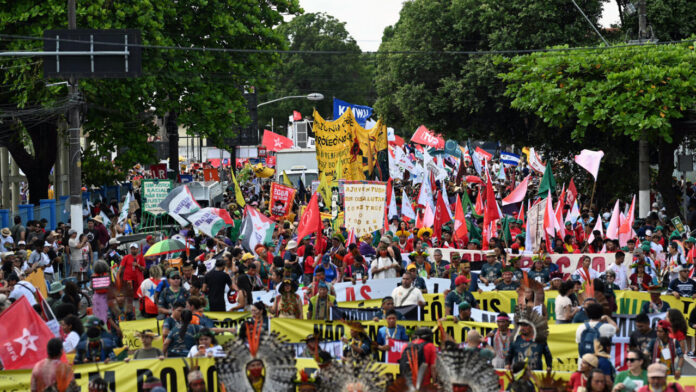
The real political heart of Belém was not the gated COP venue but the People’s Summit and the mass march on 15 November. Over several days, more than 70,000 people gathered in and around the Pará Federal University campus and the streets of the city: Indigenous communities, Afro-descendant quilombola groups, peasants, fisherfolk, trade unionists, feminist and LGBTQIA+ movements, urban poor organisations and international networks.
The 15 November march in particular condensed the social character of this resistance. The majority of participants were women – Indigenous, Black, peasant, urban – whose labour sustains both agricultural production and the invisible work of social reproduction. Movements like the Landless Rural Workers’ Movement (MST), the Unified Workers’ Central (CUT), the Movement of People Affected by Dams and the Movement of People Affected by Mining brought to the streets decades of struggle against dams, mines, agribusiness and precarious work. Their banners and slogans – “Demarcação já!” (Immediate demarcation of Indigenous territories), “Petroleum out of the Amazon!”, “Water belongs to the people!”, “Industrial agriculture is death!” – left no doubt that the target was not only “emissions” in the abstract but concrete forms of capitalist exploitation and colonial dispossession.
For many participants, the march represented not a “side event” but the true centre of COP30 – a collective rehearsal for the kind of power that will be needed to force a real phase-out of fossil fuels and a just transition.
The People’s Summit Declaration, emerging from months of discussion, made this explicit. It identified capitalism as the root cause of the climate crisis, denounced transnational corporations and imperialist states, rejected market-based “false solutions” like carbon offsets and financialised forest funds, and called for a radical reorganisation of production, energy systems and land use based on popular sovereignty, feminist justice and Indigenous rights.
Lula, the State and the Left: Contradictions of a “Green” Government
A central debate in Belém revolved around the role of the Lula government and, more broadly, the strategic relationship between left parties in power and social movements. The Workers’ Party (PT) has deep historical links with many of the organisations present at the Summit, including MST and key trade unions. Lula’s third term has restored many democratic guarantees destroyed under Bolsonaro and has taken important steps to reduce deforestation. At the same time, his government has authorised new oil and gas exploration, maintained agribusiness as the backbone of Brazilian exports and embraced financial instruments like TFFF as the core of its green diplomacy.
This duality was visible in Belém. The state covered the bulk of the People’s Summit budget and sought to present it internationally as a “complement” to the official COP. Ministers from health, agriculture and environment attended sessions, signalling that Brazil was doing what authoritarian hosts like Egypt, the UAE or Azerbaijan could not: opening space for civil society. Yet many radical organisations warned that this support came with a price: pressure to soften criticisms of the government’s own fossil and extractivist policies. Behind closed doors, there were intense debates about how sharply the Summit’s declaration should name projects like offshore drilling in the Amazon basin or mega-dams.
Parties to the left of PT, such as PSOL, maintained a position of “critical support”: defending Lula against the far right while insisting on a full fossil phase-out, land reform and stronger Indigenous rights. This tension – between collaboration with a progressive government and autonomy of movements – is not unique to Brazil; it is a recurring dilemma for the Marxist left in the era of climate emergency. COP30 made clear that we need strategies capable of both defending democratic space and confronting the capitalist state when it functions, as it usually does, as the political organiser of capital accumulation.
Beyond False Solutions: Towards an Ecosocialist Transition
In Belém, the official discourse spoke constantly of “implementation”, “roadmaps” and “net zero pathways”. But implementation of what, and in whose interests? The dominant agenda continues to rely on three main pillars: carbon markets and pricing, public–private partnerships for green infrastructure, and technologies like carbon capture and storage that allow continued fossil extraction with the promise of future “clean-up”. These are not technical details; they are class strategies.
Carbon markets turn the right to pollute into a tradable commodity, rewarding those who can pay while leaving the underlying energy system intact. Forest funds like TFFF convert entire biomes into collateral for global finance. Corporate-driven “just transition” plans seek to guarantee investor profits while offering workers at best retraining and at worst managed unemployment. Even when fossil phase-out language appears in draft COP texts, it is usually hedged with caveats about “unabated” fuels, “technological neutrality” and “transition fuels” – the same vocabulary pushed by fossil and agribusiness lobbies that flooded COP30.
A Marxist strategy starts from a different premise: the climate crisis is not a malfunction that can be fixed inside capitalism; it is an expression of the system’s normal operation. Halting ecological collapse requires a rapid and planned reduction of fossil fuel production, an end to destructive extractivism, and massive investment in low-carbon livelihoods – all of which imply a frontal clash with the interests of capital.
Concretely, that means:
- Public and social ownership of energy, transport and key industries, under workers’ and community control.
- A democratically planned phase-out of fossil fuels, with guaranteed, well-paid jobs and income for workers and communities currently dependent on those sectors.
- Radical agrarian reform and a shift to agroecology and food sovereignty.
- Recognition and restitution of land and territorial rights for Indigenous and traditional peoples, who are the most effective guardians of forests and waters.
- A feminist perspective in the organization of the economy around care, social reproduction and collective services, not profit.
COP30 did not deliver this agenda – it could not, given its structural constraints. But the convergence we saw in Belém – between Indigenous struggles, peasant movements, feminist and LGBTQIA+ organising, trade unions and anti-racist campaigns – points towards the kind of internationalist bloc that could force such a programme onto the historical stage.